
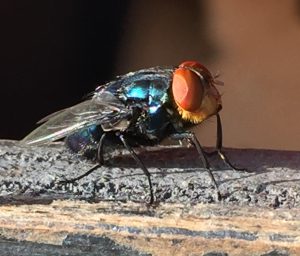
When flies lay eggs on animals (or humans) in or around wounds, or on hair, fur or feathers that are wet, matted, or contaminated with urine or feces, the hatching larvae (maggots) feed on damaged or living tissue. This infestation is called myiasis. Untreated, this condition can cause severe tissue damage and even death. Several species of flies can cause myiasis.
Most commonly, facultative myiasis or fly strike is caused by houseflies and blow flies or bottle flies. While the larvae irritate and injure layers of skin and can then move deeper into tissue, infesting a living animal is opportunistic and not an essential part of their life cycle.
Obligatory myiasis is caused by fly species producing larvae that need a living host as part of their life cycle. New World Screwworm (NWS) larvae burrow deep into healthy tissue and while wounds are easy entry points, they only need a wound the size of a tick bite. They can also attack tissue through body openings and/or mucus membranes.
Animals can be infested with maggots from NWS and other species of flies at the same time.
Although NWS has not been found in the United States outside of Texas and New Mexico to-date, larvae or eggs can be carried by animals moving from an infested area. Some states, including Michigan, have established requirements for animal movement into unaffected states. Please consult with your State Animal Health Official and/or Department of Agriculture for current import restrictions for your state.
Information for Producers and Animal Owners:
If you see unusual wounds or maggots on animals, contact your veterinarian immediately. Your veterinarian can help you assess, treat, and provide appropriate supportive care.
Talk to your veterinarian about prevention, but the most important thing you can do is to look at your animals as often as possible. Look for wounds, signs of discomfort or irritation, and the smell of decay.
Information for Veterinarians:
Please reference USDA’s NWS Information for Veterinarians: Be Aware and Prepare (PDF).
Any suspicious or unusual cases of myiasis should be reported immediately to your Area Veterinarian in Charge (AVIC) AND your State Animal Health Official (SAHO). They will work in coordination to assess the case and collect samples for laboratory submission. In some cases, you may be directed to collect specimens, but veterinarians should only do so with approval and instruction from state and/or federal officials.
In Michigan, contact the Michigan Department of Agriculture and Rural Development (MDARD) immediately at 800-292-3939 (daytime) or 517-373-0440 (after-hours).
If directed to collect specimens:
- Use forceps to collect multiple larvae of different sizes from different areas and depths of the wound—it is especially important to collect from the deepest part of the lesion.
- Place in a shatterproof vial with 70% ethanol or isopropyl alcohol (not water or formalin).
- Ensure alcohol completely covers the specimens.
- Secure a screw top or tight-fitting lid.
- If flies are present, collect adults in a dry vial with a screw top.
- If possible, take clear photos of larvae and wounds.
For more information, please see “Standard Operating Procedure for Possible Detection of New World Screwworm in Animals” from USDA APHIS.
Please View Additional Screwworm Resources for Veterinarians from:
Page Published: June 17, 2026