
Internal Medicine appointments are scheduled Monday through Thursday mornings with rechecks on Fridays.
Unless your pet is a diabetic or known to have hypoglycemia (low blood sugar), do not feed your pet after midnight the night before the appointment. Provide water and give any medication as usual. If your animal is a diabetic or has low blood sugar, feed and medicate as usual.
Please bring a copy of recent test results, radiographs (X-rays) or ultrasound, and other pertinent records with you to the appointment.
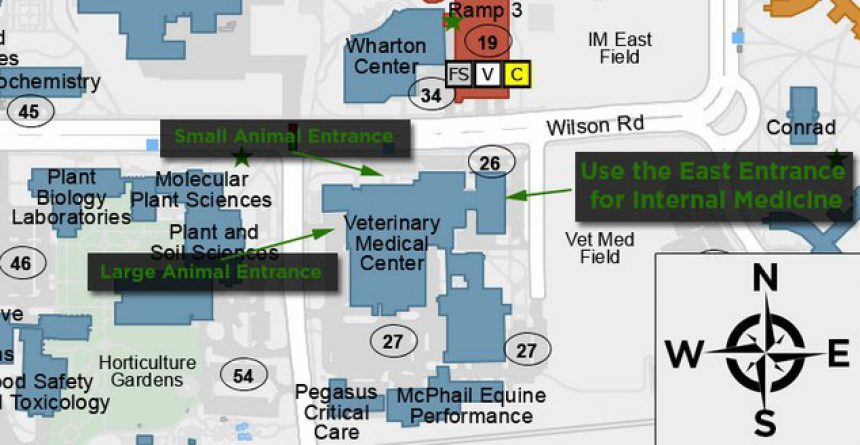
The Veterinary Medical Center has three entrances: one for large animals on the West side of the building facing Bogue Street, and two for small animals. One small animal entrance is on the North side of the building facing Wilson Road; the other is on the East end of the building. Internal medicine clients should come to the East entrance of the Small Animal Hospital and register at the reception desk. Please see the map below.
What to expect
A senior veterinary student will escort you to an exam room to take the clinical history and perform a physical examination. The student will present the case to the clinician, who will also perform a complete and thorough physical examination and review of the medical records you brought with you (previous test results, treatments, etc). Based on these initial findings and your animal’s condition, the clinician will make recommendations regarding further work-up and treatment. Many times your veterinarian will already have discussed some of these with you. Some examples include:
- Advanced laboratory testing of various tissue and blood samples.
- Diagnostic Imaging - ultrasound, radiography (x-rays), CT scan, MRI, fluoroscopy
- Biopsies of bone marrow, internal organs, or masses
- Endoscopy
- Feeding tube placement
Internal Medicine work-ups can be lengthy. Please allow 1 – 2 hours for the first consultation with the internist. Some advanced testing require hours to complete, therefore the entire visit may take all day. Sometimes an overnight stay is needed, particularly if anesthesia is necessary.
Many of these techniques require anesthesia and a stay in the hospital. The length of stay and the costs associated with these procedures will be discussed with you so that you can make an informed decision.