
MSU’s Veterinary Medical Center has partnered with Aero Med and North Flight Aero Med to launch Spartan Canine Shield, Michigan's first emergency air transport program for critically injured working dogs.
When an on-duty police dog is critically injured in the line of duty, every second counts. To ensure these specialized working dogs receive life-saving medical care as fast as possible, the Michigan State University Veterinary Medical Center (VMC) has partnered with Corewell Health AeroMed and North Flight Aero Med (NFAM) to launch the Spartan Shield program, a pioneering initiative establishing dedicated medical air transport for operational K-9s across the state.
"It was a pure expression of teamwork. That's how we view our partnership with Aero Med/NFAM–standing shoulder-to-shoulder to protect these dogs who put themselves in harm's way to protect our communities," says Matthew Beal, DVM, emergency and critical care specialist at the MSU VMC and lead on this new initiative. While the concept began with a vision of landing helicopters on campus to deliver canine patients, building a seamless transport protocol required a network of collaborators across the state and university.
The Spartan Shield program relies on a multi-agency infrastructure involving the MSU Department of Police and Public Safety, Ingham County 911 dispatch, and custom dispatch protocols engineered by MSU IT and Communications. When an operational canine is injured in Michigan, a call sets off a rapid notification system across the VMC.
"At the push of a button, a system sends an immediate alert to our team," Beal explains. "Whether it's 11 p.m., 2 a.m., or a Sunday afternoon, our specialists in surgery, anesthesia, emergency medicine, critical care, blood banking, and imaging all converge on the hospital so we are fully prepped the moment that flight touches down."
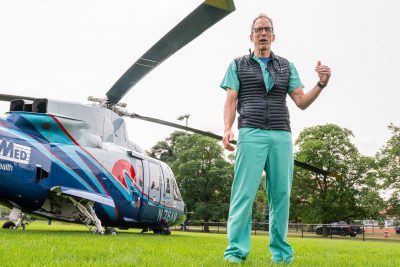
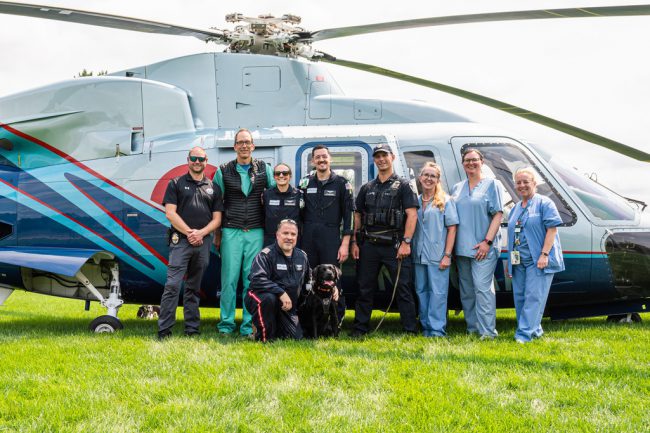
Equally critical to the program's success is the specialized training provided by Aero Med / NFAM medical teams. VMC clinicians spent hands-on training time with Aero Med/NFAM flight nurses in Grand Rapids and Traverse City, equipping these critical care providers with essential veterinary emergency medicine protocols. By pairing their knowledge of human trauma care with specialized canine care, flight crews can stabilize and help working dogs during high-speed transit.
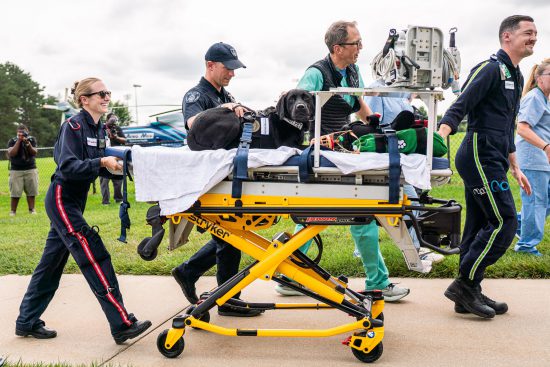
During a recent live test on MSU's campus, teams successfully practiced receiving a simulated patient–Shadow, a black Labrador retriever who routinely serves as a blood donor for the VMC. Shadow, who serves in the Canine Unit of the MSU DPPS, was airlifted by an AeroMed crew, safely offloaded by handlers and veterinary medical personnel, and wheeled into the VMC emergency center.
While the simulation demonstrated that the program could operate successfully, the ultimate hope is to use it as sparingly as possible. "We're thrilled that this infrastructure is officially in place, but we honestly hope we never have to press that button," Beal says. "Because if we do, it means a brave dog—and potentially human officers—have been critically injured in the line of duty. But if that call comes, MSU and Aero Med / NFAM are ready."
Flight teams are trained for:
- Trauma/bleeding
- Heat illness
- Airway obstructions
- Cardiac arrest
- Burns
- Opioid O.D./ poisoning
- Gastric dilation and volvulus
Specialized equipment for K9s:
- Advanced airways
- Muzzles
- Oxygen masks
- Bleeding control
- Intravenous fluids
- Medications
Are you interested in supporting the MSU Spartan K9 Shield program? Donate to the Spartan Shield fund here.