
Mentor Training Curriculum
Mentoring Across Differences: Facilitation Guide Mentoring Across Differences: Participant HandoutsThe quality of a summer research experience depends on effective mentorship. Faculty from Michigan State University and Howard University, in consultation with the Center for the Improvement of Mentored Experiences in Research (CIMER) staff, developed Mentoring Across Differences, which is a mentor training tool grounded in experiences relevant to minoritized students in biomedical summer research programs.
As the diversity of students pursuing science education grows, mentors at predominantly white institutions (PWIs) are increasingly mentoring students from populations historically excluded from the biomedical sciences based on race and/or ethnicity. This results in mentor-mentee pairings that are cross-race and/or cross-ethnicity. While most mentors are accomplished scientists who are committed to supporting their trainees, some may feel they lack the experience or tools to fully understand the perspectives of students from underrepresented groups. As a result, mentors may feel underprepared to recognize and address microaggressions, engage in difficult conversations, and effectively support the experiences of underrepresented trainees.
This challenge is particularly acute in short-term experiences, such as summer internships, where there is a limited window to create mentoring relationships that are inclusive, supportive, and promote trainees’ science identity and persistence in biomedical research and related careers. To address this need, we developed the Mentoring Across Differences mentor-training curriculum, which is grounded in validated learning objectives and informed by survey and interview data (Figure 1) from alumni of the BRUSH Summer Research Program (Ewart et. al., JVME 2024 DOI: 10.3138/jvme-2024-0045).
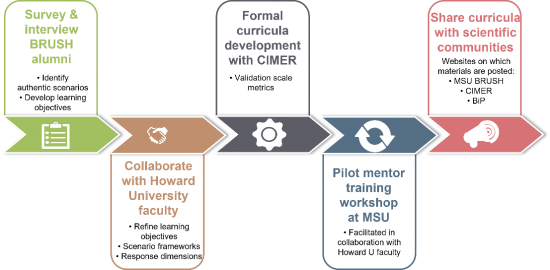
The Mentoring Across Differences curriculum incorporates scenario-based exercises with guiding questions, along with activities that promote reflection and discussion. It is designed for small-group workshops (up to approximately 30 participants), facilitated by one or two leaders who guide conversations on key mentoring topics. This format encourages participants to share perspectives and draw on the collective expertise of the group, fostering a collaborative learning environment.
Importantly, the Mentoring Across Differences curriculum extends beyond reliance on in-room discussion alone. While sharing collective wisdom is valuable, its relevance may be limited in groups composed primarily of majority demographics. Accordingly, the curriculum intentionally integrates insights derived both from empirical data and from the lived experiences of its designers, ensuring that participants engage with a broader and more representative body of perspectives.
Two documents are provided with all required curricular materials. The Facilitation Guide offers detailed instructions for facilitators, while the Participant Handouts include both core and optional materials for distribution to workshop participants.
The core curriculum is designed for a 2-hour session. Optional components may be incorporated to extend the session, and the material can also be divided into two 1-hour sessions, if needed.