
Donald R. Myers and William E. Dunlap established an Endowed Chair in Canine Health in the Department of Small Animal Clinical Sciences. The endowment supports the most advanced research, scholarship, and graduate student education to advance knowledge and enhance the health of dogs. As part of developing a world-class research program in canine health, the College envisions the Myers-Dunlap Chair to serve as a research mentor to faculty and a resource for developing other departmental and College research programs.
Dr. Simon Petersen-Jones is the Donald R. Myers and William E. Dunlap Endowed Chair in Canine Health. The Petersen-Jones Laboratory focuses on hereditary eye diseases in animals—primarily retinal degeneration phenotypes, and particularly the development of large animal models for retinal degeneration research. Current active studies include ocular melanosis, progressive retinal atrophy, cataracts in papillons, and comparative gene therapy.
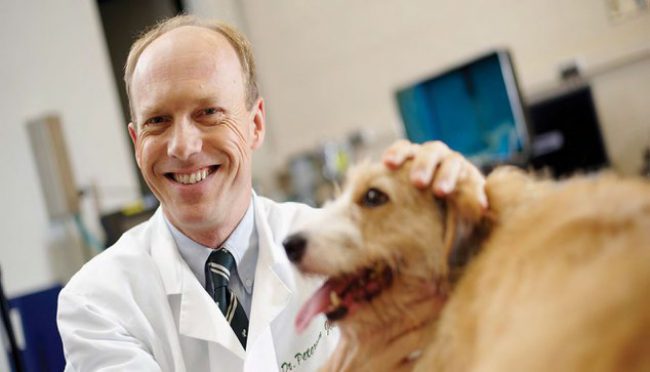
Petersen-Jones earned his veterinary degree at the Royal Veterinary College, University of London, UK in 1983. After 18 months in general practice, he returned to the Royal Veterinary College to complete a four-year residency in ophthalmology. He was awarded the Royal College of Veterinary Surgeons' specialist qualification in ophthalmology and then, in 1995, became a diplomate of the European College of Veterinary Ophthalmologists.
He was head of the Ophthalmology Service at University of Edinburgh, Scotland from 1988 to 1994. Then, from 1994–1998, he was a Wellcome Trust Veterinary Research Career Development Fellow at the University of Cambridge, UK, where he also taught the ophthalmology course. He was awarded a PhD for his research into hereditary retinal diseases in dogs. He has been on the faculty at Michigan State University since 1998.
Petersen-Jones has received awards for his contributions to veterinary science from the British Small Animal Veterinary Association and from Pfizer for his research achievements. He is co-editor of Small Animal Ophthalmology, the world's best-selling veterinary ophthalmology text, and the BSAVA "Manual of Small Animal Ophthalmology - A Problem Oriented Approach." He has written numerous book chapters and scientific articles on different aspects of veterinary ophthalmology and lectured in many countries around the world.
As a specialist clinical veterinary ophthalmologist with a PhD in molecular genetics, Petersen-Jones has long had an interest in hereditary eye disease in animals. During the past 20 years, he has concentrated predominantly on retinal degeneration phenotypes and, in particular, the development of large animal models for retinal degeneration research. Several forms of spontaneous inherited retinal degenerations exist in the pet dog and cat population.
Donald R. Myers and William E. Dunlap
Because of their devotion to Michigan State University and their beloved miniature Schnauzers, Donald R. Myers and William E. Dunlap established an Endowed Chair in Canine Health in the Department of Small Animal Clinical Sciences. Their goal was simple: to help Michigan State University and to help dogs. How this would be accomplished was left to their friends in the College to determine.
Their endowment supports high-quality, trend-setting research, scholarship, and graduate student education that will advance knowledge and enhance the health of dogs. In addition to establishing a world-class research program in canine health, the College also envisions the Meyers-Dunlap Chair to be a research mentor to faculty and a resource for development of other departmental and college research programs.
Two great pleasures for Myers (MSU ’50) and Dunlap were their dogs and MSU. Often, they were seen with their Miniature Schnauzers at MSU football games. They determined that an endowment was a way for them to support MSU and to help advance the medical care of dogs. Curtis Probst, professor emeritus for the Department of Small Animal Clinical Sciences, was instrumental in facilitating this gift, which was established in 1999. Dunlap passed away in 2003, and Myers died in 2008.
In addition to this endowment, the couple also made a gift to the College’s Comparative Oncology Center.