
A new clinic on wheels is closing the veterinary care gap across Michigan, one mile at a time. See how this state-of-the-art mobile unit is serving as a game-changing lifeline for overwhelmed shelters and a hands-on classroom for future Spartans.
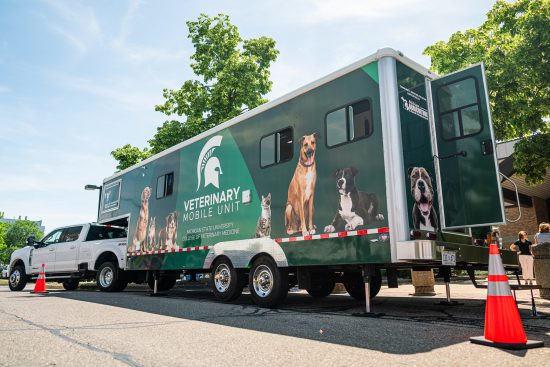
Michigan’s animal shelters are often overwhelmed with a high volume of animals in need of homes. For many organizations, access to consistent veterinary services — especially spay and neuter surgeries, which are required to adopt out dogs and cats — can be one of the biggest barriers to moving animals into homes.
The Community Medicine Program at the Michigan State University College of Veterinary is a mobile veterinary surgical suite staffed by Spartan veterinarians, technicians, and clinical students, and was created to help close that gap, one mile at a time.
A Mobile Model with a Dual Mission
Launching in spring 2026, the program combines two missions: expanding access to veterinary care for underserved communities while training the next generation of veterinarians and veterinary nurses. At the center of the initiative is a custom-built, 32-foot mobile surgical unit designed to bring high-quality medical care directly to animal welfare organizations across Michigan.
More than a trailer, the mobile unit functions as a fully operational clinic on wheels. Equipped with two surgical tables, advanced anesthesia monitoring equipment, an onboard generator, and a climate-controlled recovery area, the unit allows MSU teams to perform efficient, high-standard care in communities that may otherwise struggle to access veterinary services. Initially, the program will serve organizations within a roughly two-hour radius of MSU’s campus.
The program is led by David Emery, DVM, and Rebecca Wood, LVT. Together, they bring experience spanning animal welfare, emergency medicine, wildlife rehabilitation, and shelter care.
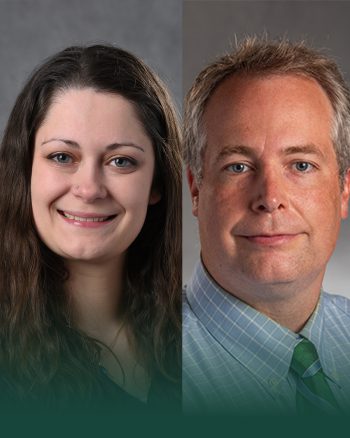
Emery has spent more than a decade working in a variety of veterinary settings, including commercial veterinary hospitals, private practice, and the Michigan Humane Society. In addition to serving as an assistant professor of primary care medicine, Emery is the faculty advisor to the shelter medicine club and the street medicine student organization. His work reflects his focus on expanding access to veterinary care.
Wood’s background is also diverse and includes work in conservation, emergency care, and specialty medicine. These experiences have shaped her belief that veterinary medicine is most effective when it considers both the animal and the environment around it.
Both are passionate about education and are excited not only to care for the animals in need, but also to provide an opportunity to prepare future veterinarians and veterinary nurses to serve communities where resources are often limited.
Lessons Beyond the Classroom
Every clinic day doubles as a hands-on classroom for fourth-year veterinary students and clinical veterinary nursing students. Under direct supervision, students perform surgeries, monitor anesthesia, and participate in patient recovery while gaining real-world experience in shelter medicine and community care.
For fourth-year DVM student Danielle Mansour, signing up for the Community Medicine Program was an easy decision. Her path to veterinary medicine began in an animal shelter, and she says this kind of work has always interested her.
“Shelter medicine taught me basic clinical skills that I constantly looked back on during my clinical year,” Mansour says, “so any chance I have to get back into community medicine, I take.”
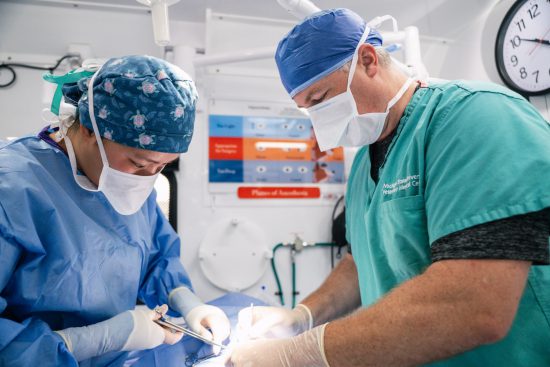
Recent graduates Grace Self, DVM, and Alexandra Hill, DVM, were both drawn to volunteer with the program. Hill, now a small animal rotating intern with the College, signed up just days after Emery put out the call for volunteers.
“I signed up for as many dates as I could,” Hill says. “Dr. Emery taught me so many great surgical tricks while allowing me the opportunity to learn and try things on my own.”
Inside the mobile unit, all three found something that surprised them. Mansour noted the adjustable surgical tables that helped her feel comfortable during days with many surgeries. Hill was impressed that the trailer contained features like digital monitors, gas anesthesia, and temperature-controlled surfaces. Self highlighted the positive atmosphere inside the unit, created by both the students and faculty.
“Veterinary medicine can be chaotic in its own way,” Self says. “It was awesome seeing a group of people, many for the first time, get together as a team to accomplish our tasks for the day.”
The program is structured as a three-week clinical clerkship, designed to help students build confidence, efficiency, and sound clinical judgment before entering professional practice. By working in high-volume surgical settings and underserved communities, students are also exposed to the broader challenges surrounding access to veterinary care across Michigan.
“Being able to give back to the community is something I want to incorporate into practice,” Self says. “This experience just helps solidify that drive.”
“I’m someone who asks a lot of questions,” Mansour says. “Meeting with different community members and being able to learn from them is the kind of veterinarian I want to be when I’m older.”
Supporting the Front Lines of Animal Care
For shelters and animal control centers across Michigan, the impact of this partnership is both immediate and cumulative.
At the Humane Society of Monroe County, Executive Director Jacqueline Monteer says the first visit alone made a measurable difference. The Community Medicine team performed 9 spay and neuter surgeries, resulting in more than $1,000 in savings for the organization in a single day.
“We are full all the time,” Monteer says, noting that the shelter typically houses between 60 and 90 dogs, along with dozens of cats. “We are a nonprofit, so we’re not supported by any government agencies. I can’t even tell you how much it means to us that the mobile unit came out here to help us with spays and neuters.”
Beyond the financial relief, Monteer emphasizes the value of MSU’s presence as a teaching and collaborative partner. The MSU team and the shelter staff exchanged ideas on animal handling, medical concerns, and shelter operations, with cases reviewed in real time to support both learning and care decisions.
“It provides an opportunity for the student veterinarians to see something they wouldn’t see in practice very often,” she says. “It gives them a good perspective on how difficult running a shelter is, but also how much of a difference they can make.”
That dual focus—service and education—also stood out at Kalamazoo County Animal Services, where Director Chad Ensign describes the mobile unit as a “two-fold success.” By providing care for shelter animals on-site, the Community Medicine Service helps free up appointment capacity in local veterinary clinics, increasing access for pet owners in the broader community.
“It opens those spots up to the public,” Ensign says. “And for a first visit, it went so smoothly. Everyone was so professional and communicative.”
At the Humane Society of Branch County, where resources have been particularly limited, the new service has already become a critical lifeline.
Shelter Manager Jan Nageldinger describes the program as “a game changer,” citing both financial strain and chronic overcapacity.
“We were in the red, we have a million cats, and our vet bills are high,” she says. “This is just a wonderful blessing for us.”
The shelter, which operates without county or state funding, has long struggled to keep up with demand. Preventative services provided by MSU allow animals to be sterilized before entering broader rescue networks, increasing their chances of adoption and reducing long-term strain on the system.
“If we can say a dog is already fixed, other shelters are more likely to help,” Nageldinger explains.
Across all of the shelters that the service has visited so far, a consistent theme has emerged: the partnership not only provides veterinary care, but also helps organizations stretch limited resources, better meet community needs, and build stronger foundations for long-term impact.
The program’s “growth through success” model is designed precisely for that shift. By supporting shelters so effectively that their need for emergency intervention gradually decreases, MSU is able to expand into new communities while strengthening existing partners. That model of care, collaboration, and capacity-building defines the program’s broader goal.
A Partnership with Purpose
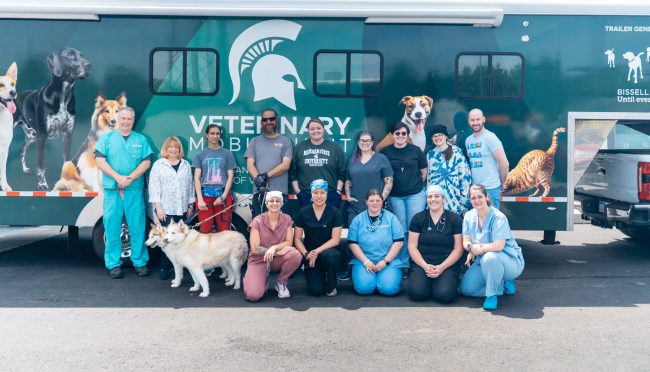
For the students involved, the experience offers invaluable clinical training. For shelters, it provides desperately needed medical support. And for thousands of animals across Michigan, it could mean a faster path from uncertainty to a permanent home.
The Community Medicine Program was made possible through support from organizations including the BISSELL Pet Foundation and the Michigan Department of Agriculture and Rural Development.