
For Desiderio Torres, every classroom he stepped into was a hard-won opportunity. He was born in the province of Salta, Argentina, in a place without basic services, such as water and electricity. Around the age of four, his family moved to El Talar, a rural agricultural town in the neighboring province of Jujuy, where access to consistent schooling was limited. For Torres and his siblings—he has six brothers and two sisters—the focus was often on day-to-day necessities.
“Sometimes we just had one meal a day,” says Torres. “I remember not knowing what the word ‘supper’ meant because we just never had it.”
In this small town, even finishing elementary school was an accomplishment. High school wasn’t an option—until it unexpectedly became one for Torres.
A visiting professor came to El Talar and helped establish a local high school just as Torres was wrapping up sixth grade. With no dedicated space, the high school shared the elementary school building, holding classes at night. For Torres and other students, this opened a door that wasn’t possible before.
“Without him, a lot of kids would have ended up with just elementary school,” says Torres. “High school was an impossible dream until he came and gathered resources and people.”
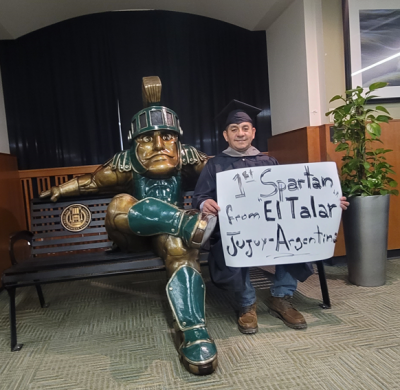
After Torres graduated from high school, another opportunity he once thought was impossible presented itself. A teacher of Torres’s was moving with his wife to another province called Tucumán, home to one of the best universities in the country. Before departing, the teacher approached a small group of recent high school graduates with an offer: if they were willing to work, they could stay with him for a year and continue their education.
For Torres, the idea felt almost unimaginable. The city was hundreds of kilometers away—far beyond anywhere he had ever been—and the cost of getting there alone seemed out of reach. But with encouragement from his family, including an older sister who promised to support him however she could, he took the chance. Alongside a handful of other students, Torres left behind the only life he had known and stepped into an entirely new world.
“It was a new city, a new culture, a new way of life,” says Torres.
Financial hardship made Torres’s college years even more difficult. He often had to choose between paying for transportation or food, walking hours each day to attend classes. He struggled academically at first and had to repeat courses, but he refused to give up.
“I didn’t want to go back home and ask ‘what if’ for the rest of my life,” he says. “So I held on. I wasn’t letting go until I finished.”
Every other student who had come from El Talar with Torres eventually dropped out, but Torres’s persistence paid off. Upon graduating, he became the first person from his town to earn a college degree.
“I was in the newspaper for that,” remembers Torres. “My friend posted it on every light post in town, and my mom still has a copy.”
But even that milestone didn’t guarantee opportunity. Despite now having a degree in agriculture, Torres still struggled to find work. Eventually, he made another life-changing decision: moving to the United States.
In 2002, with the help of his sister—who had moved to the US in the late ‘90s—Torres moved to New York. Once again, he found himself navigating a completely unfamiliar culture. He got a job as a dental assistant, but while the job provided stability, it wasn’t particularly fulfilling.
“It felt like I had gone to college and studied agriculture for nothing,” recalls Torres. “I wanted something more.”
That “something more” came when he followed his sister down to Florida and began working at a tomato farm. After a few years, Torres’s supervisor approached him about stepping into a new role to support the operation’s food safety procedures. Torres jumped at the chance, eager to take on more responsibility.
Wanting to deepen his knowledge, Torres attended a local food safety training course, which gave him a clearer sense of the field and confirmed that he wanted to pursue it further. It was at this course that Torres was introduced to the idea of continuing his education through an online program at Michigan State University.
“I heard it was the best program, and I thought it sounded like a great way to grow,” says Torres.
With encouragement from his wife Tamika, Torres enrolled in the Online Master of Science in Food Safety Program at MSU in 2020. After balancing work, school, and raising young children for a few months, Torres left the tomato farm in 2021 to fully dedicate himself to his studies and his family.
In the program, Torres gained a deep understanding of food safety principles, from regulatory compliance to risk management, and learned how to apply them in real-world settings. He credits the curriculum and the instructors with giving him practical tools to tackle complex challenges in the industry. After years of hard work, Torres graduated with his master’s degree in December 2025.
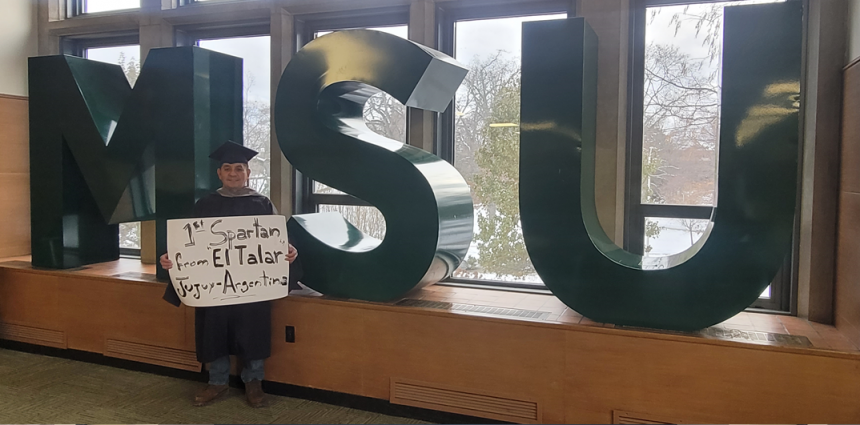
“A lot of people throw around the words ‘life-changing,’” says Torres. “But for me, that’s literally what happened. I gained knowledge, confidence, and a completely different way of thinking.”
Today, Torres is building his own food safety consulting business, applying what he learned to help others improve practices and protect public health. He continues to grow his client base while offering training and guidance across the industry.
More than the professional opportunities, earning his degree represents something deeply personal for Torres.
“I was the only one from my town who finished university, and now I have a degree from one of the best programs in the United States. I mean, come on!” he laughs. “I have an MSU cup and a Spartan license plate frame for my truck. Every time I see that logo, I still can’t believe it.”
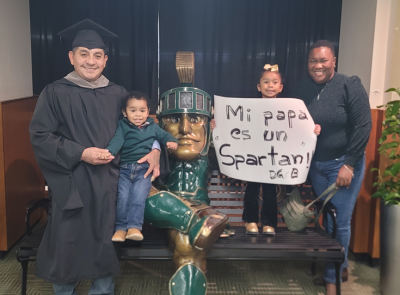
For those considering a master’s in food safety from MSU, Torres offers encouragement rooted in experience.
“The program will be beneficial to anyone who enrolls,” he says. “There are people from all over the world with so much knowledge to share, and the instructors really invest in your success.”
From a childhood without basic resources to becoming an international graduate of a leading program, Torres sees his journey as bigger than himself. He hopes his path demonstrates to his children not only the value of education, but of perseverance.
“I have three daughters and a son,” says Torres. “The older ones are so proud, and the younger ones will feel that later on. I hope they see that I raised the bar for myself to give them a better starting point than I had.”