“He was a steady, efficient dean who took good care of the College.”
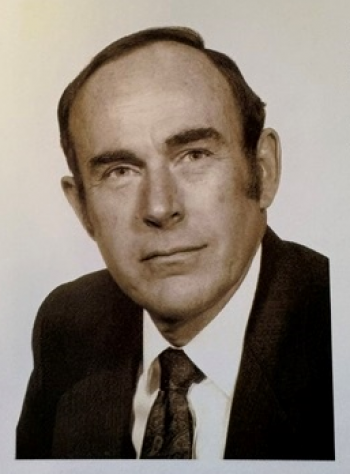
For Dr. Jim Sikarskie, the words capture the essence of former Dean John B. Tasker, whose nine years of leadership helped guide the College through a period of significant growth and change.
Tasker brought a broad academic and professional background to Michigan State University when he became the College of Veterinary Medicine’s seventh dean in 1984. A native of New Hampshire, he earned his DVM degree from Cornell University in 1957 and his PhD in veterinary pathology in 1963. He went on to teach veterinary clinical pathology at Colorado State University and Cornell University before serving as associate dean at Louisiana State University’s School of Veterinary Medicine, where he gained extensive experience in academic administration.
He arrived at MSU with a clear understanding of the challenges ahead. The College was working to restore full accreditation of its professional program while also facing the need for significant improvements to its physical facilities, increased financial support, and continued investment in research. In announcing his appointment, Tasker identified these priorities as central to his vision for the College.
“It is a challenging opportunity to become a part of the long history of quality veterinary education, research, and service at MSU,” Tasker said shortly after his appointment. “I am optimistic about working constructively with the outstanding faculty and university administrators in moving MSU’s veterinary program forward.”
Over the next nine years, Tasker would lead the College through a pivotal period in its history, one marked by both significant challenges and impressive growth.
Building for the Future
Tasker's most visible legacy can be seen in the College's physical transformation during the late 1980s and early 1990s.
Not long after arriving at MSU, Tasker expanded the administrative responsibilities of Dr. Jack Judy, who took on a leading role in developing plans for a major capital expansion and directing the construction and renovation of the Veterinary Clinical Center.
The effort culminated in the construction of the G-building and extensive renovations throughout the clinical hospital. Formally opened in January 1991, the new building was designed to accommodate teaching, research, animal holding facilities, and administrative offices. The hospital renovations brought improved examination and treatment spaces for large and small animals, new surgery suites, radiology rooms, a pharmacy, and an expanded clinical pathology laboratory.
The improvements were significant enough to prompt a new name for the complex. The Veterinary Clinical Center became the Veterinary Teaching Hospital, and the entire complex was renamed the Veterinary Medical Center in September 1991.
The new facilities represented a major step forward for the College's educational and clinical missions—one that continues to be felt.
“The G building that opened under Dean Tasker’s leadership was critical to the modernization of teaching for the College of Veterinary Medicine,” says Dr. Ann Duncan, part of the DVM Class of 1991 and an adjunct professor at the College. “Now as an adjunct faculty member, I still use the space to engage students in meaningful conversations.”
For Tasker, improving the College's physical plant had been a priority from the beginning. In outlining his goals for his new deanship, he identified restoring full accreditation as the College's overriding objective and improving its facilities as an essential part of that effort.
By the time of the College's 1990s accreditation review, the newly opened G-building and expanded clinical facilities were among the changes that helped demonstrate the College's progress. The College regained full accreditation, marking an important milestone in Tasker's tenure.
Strengthening the Academic Mission
Tasker also recognized that a strong veterinary college required more than modern buildings. Research, he believed, was essential to advancing both education and clinical service.
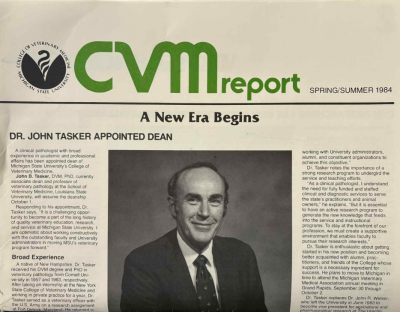
“As a clinical pathologist, I understand the need for fully funded and staffed clinical and diagnostic services to serve the state’s practitioners and animal owners,” he said upon his appointment. “It is essential to have an active research program to generate the new knowledge that feeds into the service and instructional programs.”
Tasker’s emphasis on research as a cornerstone of the College’s mission was reflected in significant growth in research funding. By 1988, the College received $3.1 million in extramural research support.
The period also saw the establishment of the College's first endowed chairs, creating new opportunities to recruit distinguished faculty and advance research in areas of importance to both veterinary and human health. In 1985, a grant from the estate of longtime MSU supporter Matilda R. Wilson endowed the Matilda R. Wilson Chair in Large Animal Clinical Sciences, and the Wade O'Brinker Chair of Veterinary Surgery was also fully funded during the mid-1980s through contributions from more than 1,200 donors.
Tasker also led the College through significant changes to its professional curriculum, which had been under development for several years in advance of MSU’s switch from a quarter system to semesters in 1992. The veterinary school’s new program comprised five semesters of preclinical basic medical science and three semesters of clinical veterinary education.
The restructured curriculum “allowed students to plan some of their own individual schedules, which included several optional clerkships and a choice of up to five approved off-campus veterinary experiences,” note Drs. Janver D. Krehbiel and Frederik J. Derksen in their book, A History of Michigan State University’s College of Veterinary Medicine.
The changes reflected a broader effort to prepare students for the evolving demands of the veterinary profession while giving them more opportunities to tailor their education to their interests and career goals.
Levelheaded Leadership and a Lasting Legacy
Tasker's nine years as dean were not without challenges. The economic downturn of the late 1980s and early 1990s brought declining federal and state support for higher education. MSU entered a period of financial conservatism and implemented “R-cubed”—Refocus, Rebalance, and Refine—a program that resulted in reduced funding across the university.
Yet amid those challenges, the College continued moving forward. Major capital projects were completed. Research funding grew. Endowed chairs were established. The curriculum was restructured. Clinical facilities were expanded. By the time Tasker retired as dean in 1993, he had helped guide the College through one of the most consequential periods of institutional growth in its history.
That legacy is perhaps best understood through the facilities, institutions, and opportunities that remain. The G-building continues to serve the College's educational mission. The Veterinary Medical Center continues to provide clinical care and train future veterinarians. Research programs established and strengthened during Tasker's tenure continue to contribute to the advancement of One Health initiatives. And students and faculty continue to learn, teach and conduct research in a College that is better equipped because of the foundation he helped build.
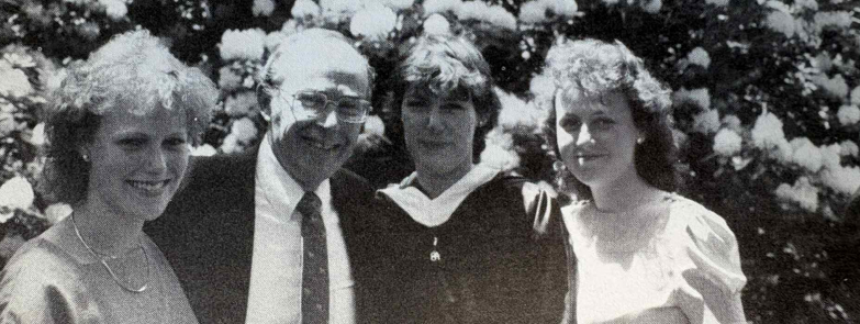
John B. Tasker died January 30, 2026, at the age of 92. He is remembered not only for his distinguished career as a veterinary clinical pathologist, educator, and national leader in veterinary medicine, but also as a loving father, grandfather, and uncle. He is survived by his three daughters and four grandchildren. His niece, Dr. Linda Chang, also became a veterinarian, earning her DVM degree from Colorado State University in 1993.
In the years since Tasker’s deanship, the College has continued to evolve. Yet the buildings, programs, and academic foundations strengthened during his time at MSU remain a part of the College’s ongoing story—a lasting reflection of a dean who understood that moving veterinary medicine forward meant building carefully for the future.