
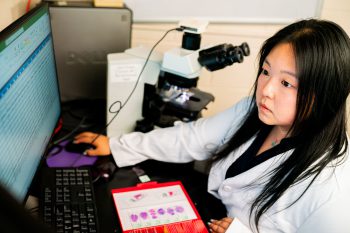
In the quiet labs of the Michigan State University College of Veterinary Medicine and during the morning rounds at regional zoological parks, a pair of student researchers are helping tackle a pressing challenge in modern conservation: protecting the reproductive health and genetic diversity of some of the world's most vulnerable wildlife.
As Morris Veterinary Scholars, Yuri Kim and Abigail Boss spend their summer immersed in a mix of high-tech pathology and hands-on clinical medicine. Working under the guidance of Dr. Dalen Agnew, chair of the Department of Pathobiology and Diagnostic Investigation, their research aims to bridge decades of historical data with the immediate medical needs of endangered species.
"Getting a taste of science early in your veterinary career not only gets people interested in doing research but provides a basis for the students to understand what they are learning in class at a deeper level," says Agnew. "Research on wildlife and conservation topics is usually poorly funded—not like research into cancer or heart disease in humans. Yuri and Abby's work is something we would not be able to get done easily without their efforts and enthusiasm.”
Unlocking the Secrets of Male Fertility in African Painted Dogs
For Yuri Kim, a second-year veterinary student, the motivation to pursue exotic and wildlife medicine comes from a personal place. Growing up with exotic pets, she remembers the barriers to finding specialized veterinary care.
"I owned a lot of exotic animals growing up, and it was hard to find veterinary care in my area for them," Kim says. "I remember back then it was so intense—I had to drive out three hours just to find someone who would be willing to see my animal. One of my big passions is expanding access to care, and if I can help the community in that sense, ease some suffering, and help animals go back out into the wild when possible, that would be wonderful."
This summer, Kim's focus is on African painted dogs —one of the world's most endangered carnivores. Pack dynamics in painted dogs are uniquely strict: a single dominant pair handles virtually all breeding for the entire group, and they mate for life. Because breeding responsibility rests on so few individuals, subtle changes in male fertility can have major consequences for the pack's survival.
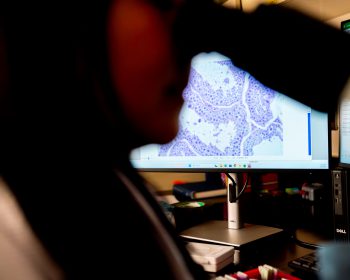
Working in Agnew's lab, Kim uses a camera-mounted microscope to examine testicular tissue slides, searching for microscopic indicators of disease or age-related degeneration that could impact reproductive viability.
"We are looking for any signs of different diseases that can affect fertility," Kim says. "As we age, these systems degrade naturally, and we are looking to see how that will affect the function of the testicle."
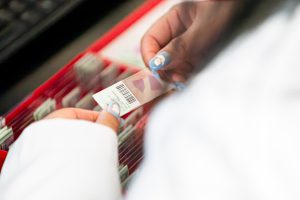
To source those tissues, the lab relies heavily on partner accredited facilities across the country.
"A lot of our samples come from zoological institutions, either through routine surgeries or necropsies," says Kim. "It's a very ethical way of getting samples, making the most of what we have from that animal to advance their medicine and protect their lifespans. We don't study testicular histology as much as we do with females, so looking specifically at the male brings light to what we don't know and helps us understand when fertility might be lost in this species."
The implications of her research reach beyond the pack. "We can extrapolate a lot of that information for other species," says Kim. "The world loves One Health."
Building "Insurance Populations" for Primates
Just down the road from MSU at Potter Park Zoo, fellow scholar Abigail Boss splits her time between analyzing archival data and shadowing veterinarians during clinical rounds.
Boss' research centers on callitrichids—a family of small primates that includes marmosets and tamarins. With multiple callitrichid species considered endangered or critically endangered, Boss’s work supports conservation efforts across facilities accredited by the Association of Zoos and Aquariums (AZA), where managing populations in human care requires evidence-based reproductive protocols.
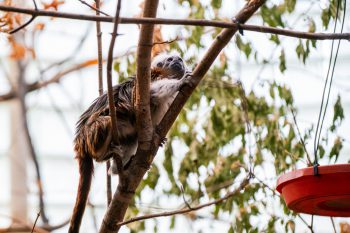
"Our goal with all AZA-accredited zoos is to build up these insurance populations so that if there were to ever be an extinction event in the wild, we would have a reservoir for the species so they aren't extinct from the earth in totality," Boss says. "We want to keep the populations in the zoos very genetically healthy and diverse."
To help accomplish this, Boss works with the Reproductive Health Surveillance Program (RHSP), an archival initiative associated with the AZA. By analyzing decades of pathology data alongside newer tissue samples—including recent cases from earlier this spring—Boss is evaluating how contraceptive methods correlate with reproductive lesions over an animal's lifespan.
In the morning, Boss shadows veterinarians Dr. Ronan Eustance and Dr. Kim Thompson at Potter Park Zoo and Binder Park Zoo, gaining clinical experience that influences her bench research.
"At both zoos, we've had patients receive progestin contraceptive implants this summer: a two-toed sloth and a ring-tailed lemur," Boss says. "Talking to Dr. Kim and Dr. Ronan about how and why they selected the method of contraception gives context to each individual whose tissue samples I'm looking at on a slide. As corny as it may sound, each of those individuals had vets thoughtfully considering and making decisions. It fine-tunes my mindset and creates an added layer of motivation."
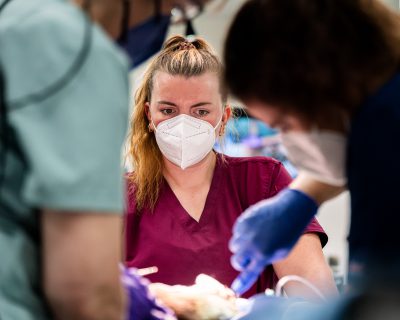
The practical value of that clinical training was on display recently when the Potter Park team treated a female guinea hog with a distended abdomen. Dr. Ronan diagnosed a severe uterine infection and operated, successfully removing a five-pound fluid-filled uterus.
"I was so impressed that the keeper team and Dr. Ronan were able to identify and diagnose her condition before she suffered any serious health implications," Boss says. "Working with Potter Park and Binder Park Zoos has developed my understanding of zoo medicine as an integrative practice. I've learned to not only roll with the punches, but to enjoy the spontaneity."
The Power of the Archive
Central to both Kim and Boss' work is the massive database curated by the Reproductive Health Surveillance Program. Housing tissue samples that date back to the 1980s, the archive lets MSU researchers investigate emergent health questions instantly without waiting years to gather fresh specimens.
"The benefit of having an archive is that I do not have to wait years to collect samples if a question comes up," Agnew says. "For example, ten years ago, no one thought polar bears would be in trouble, but we collected reproductive tracts from polar bears that died anyway for the archive. Fast forward to the present, when we now realize that polar bears are in real danger as a species and are not reproducing in zoos as we need them to save their genetic diversity. Thankfully, we do not need to wait another ten years to study them because we already have a lot of samples in our archive."
That wealth of historical data translates directly into real-world animal management and population planning.
"To manage animals in captivity, we need to manage their breeding—making sure all genetic lines are represented in the next generation while controlling the timing and number of offspring," Agnew says. "Contraception is one method, but all methods have risks. Our lab helps zoo managers and veterinarians understand those risks so they can make the best decisions for the species and for the individual animals."
Science Communication and the Next Generation
As the summer research session winds down, both Kim and Boss are converting their findings into final manuscripts and presentations for the Morris Animal Foundation. Along with the laboratory techniques and diagnostic skills they've gained, the experience has strengthened their confidence to communicate complex science to broader audiences.
"This is such a wonderful opportunity to learn from someone who knows so much about veterinary research," Kim says. "It's also a way to improve my ability to communicate my research out to the general public."
"I'm always working on my science communication," Boss says. "Working with researchers like Drs. Ronan, Kim and Agnew is so important."
For Agnew, seeing student researchers bridge the gap between abstract laboratory pathology and real-world conservation outcomes is the highest validation of the Morris Veterinary Scholar program.
"Whether they are ultimately involved in full-time research or clinical practice later on, experiences like this ensure these students become great advocates for science in our communities," Agnew says.