
For horse owners, tendon and ligament injuries can be some of the most frustrating conditions to manage. Recovery is often measured in months, reinjury is common, and even with careful rehabilitation, some horses never return to their previous level of performance.
Now, a new technology available at the Michigan State University Veterinary Medical Center is offering another option for horses whose injuries have failed to heal as expected.
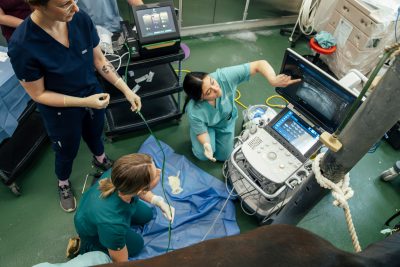
Tenex is a minimally invasive procedure, originally developed for human patients at the Mayo Clinic and now being adapted for use in equine medicine. Michigan State University is among only a handful of veterinary hospitals in the United States currently offering the technology.
“Sometimes, tendon and ligament injuries don’t heal completely or with properly organized fibers,” says Dr. Virginia Melly, an assistant professor in large animal surgery. “That abnormal tissue can contribute to persistent inflammation, pain, and delayed or incomplete healing.”
Using ultrasound guidance, veterinarians insert a specialized instrument through a tiny incision to precisely target damaged tissue within a tendon or ligament. The device uses ultrasonic energy to break apart and remove unhealthy tissue while preserving the surrounding healthy structures.
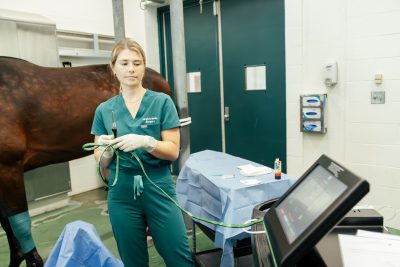
"The advantage is that we're able to reach areas that would be difficult or impossible to access surgically," Melly explains. "We're removing the tissue that isn't healing properly while causing very little disruption to the healthy tissue around it."
While general anesthesia is sometimes required, the procedure can often be done under sedation, with the horse standing. In those cases, the horse can usually return home the same day.
In the case pictured, Melly is using the technology to treat New Swan in Town (known as Francis), a horse with a chronic ligament injury that had failed to heal completely despite previous treatment. After removing the damaged tissue with Tenex, the team injected platelet-rich plasma (PRP) to help stimulate a healthier healing response.
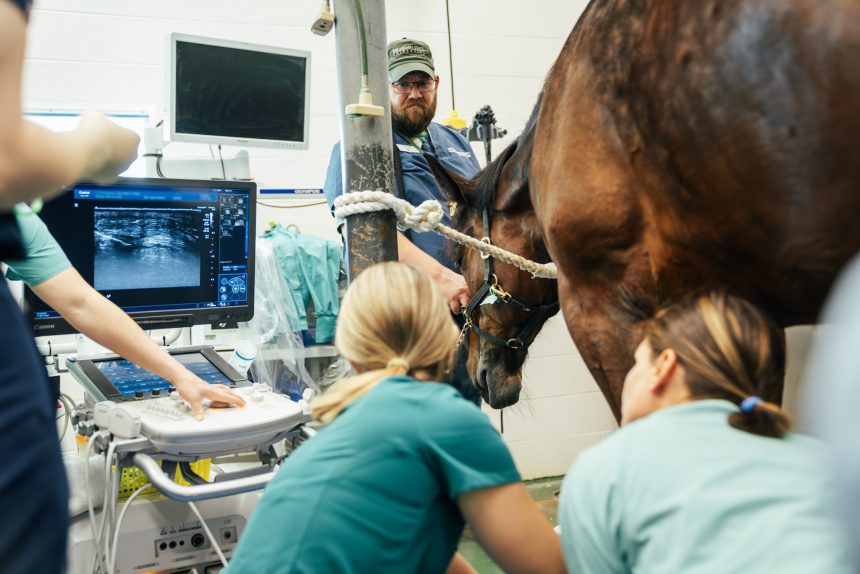
“We’re allowing the injury to restart healing from a cleaner baseline,” says Melly. “By removing the abnormal tissue and injecting an advanced biologic therapy—the PRP—we’re creating an environment that supports better healing.”
Tenex can be used for a variety of chronic tendon and ligament injuries, including injuries involving the suspensory ligament, superficial digital flexor tendon, and deep digital flexor tendon. The technology may also be useful in certain bone-related injuries where tendons and ligaments attach. While equine research on the procedure is still emerging, early reports have been encouraging, and the technology builds on a strong foundation of human clinical data.
"For horses with chronic or recurring tendon and ligament injuries, having another option is exciting," Melly says. "Our goal is always to give horses the best opportunity to heal well, and this gives us another way to do that."
Horse owners interested in learning more about Tenex or determining whether their horse may be a candidate are encouraged to contact the Large Animal Hospital.