
By Kelsie Donaldson on July 21, 2026
Headshot

When Dr. Dozie Amuzie arrived at Michigan State University from Nigeria, he was searching for the tools to tackle complex scientific problems. He found them through a unique combination of veterinary medicine and toxicology, earning a dual-major PhD in Comparative Medicine and Integrative Biology (CMIB) and Integrative Toxicological Sciences in 2009 before completing an anatomic pathology residency at the College. Today, as senior director of oncology scientific innovation and partnerships at Johnson & Johnson, he helps identify and advance promising cancer research from hundreds of organizations each year.

Ahead of his return to campus as the 2026 Phi Zeta Day keynote speaker, Amuzie reflects on the experiences that shaped his career, the state of cancer research, and his advice for students hoping to make an impact through science.
Can you talk about how you ended up with a dual-major PhD in Comparative Medicine and Integrative Toxicological Sciences? What drew you to those areas?

After I got my veterinary training in Nigeria, I wanted to study toxicology, and I knew through publications that Michigan State was very good with toxicology. Around that time, the CMIB program was just starting. Dr. Vilma Yuzbasiyan-Gurkan was running that program. I realized that the toxicology program at MSU is interdisciplinary, so if I wanted a strong anchor to the veterinary school, CMIB would provide that. I loved that program, so I ended up pursuing both to keep the veterinary aspect of my training while chasing the toxicology part that I wanted in a practical way.

How did your time at MSU shape the direction of your career?

First of all, I had very good mentors at MSU that showed me how to do rigorous research. More specifically, there was a course called Complex Diseases that brought people from many disciplines together. It was a seminar course where each trainee picks a paper, analyzes it, makes a presentation on it, and answers peers' questions around it. I hadn’t taken any course that prepared me for the complexity and rigor of the life science enterprise the way that course did.

Can you tell me a little about your role as senior director of oncology scientific innovation and partnerships at Johnson & Johnson?

In this role, I lead oncology external innovation in Western North America. By external, I mean beyond the science we have internally, we recognize that a good idea can come from anywhere in the world. So we’ve split the world into 4 zones, and I’m covering Western North America. I review and meet with several hundred companies every year and look at very good science and ideas.

I encourage the innovators and prioritize some of them for some kind of partnership with J&J. So J&J would either invest in the company so that they can continue what they’re doing, or we would license some of the intellectual property that the company develops.

What excites you most about the current landscape of oncology research and drug development?

Pancreatic cancer has historically been one of the most difficult cancers to treat, but recent advances are starting to change that. In the past year, a new therapy targeting a protein involved in the KRAS pathway has been shown to double overall survival for some pancreatic cancer patients. That’s particularly exciting because it demonstrates what's possible in an area where progress has been limited for a long time. In oncology, breakthroughs like that often open the door to multiple new approaches, and we're already seeing that happen. Beyond pancreatic cancer, I'm also encouraged by developments in cell therapies and other emerging strategies for treating solid tumors. I think these advances have the potential to make a meaningful difference for patients and their families, just as some of the J&J therapies have done when it comes to multiple myeloma.

What keeps you inspired when your research gets challenging?

I had a neighbor who had glioblastoma, and he knew that I worked for a pharmaceutical company. He’s since passed away, but just before that, I saw him taking a walk one day when I was coming home. He had just gone for surgery, and I stopped to talk to him. He said, “I heard you work for a pharmaceutical company.” I said yes, and he said, “You guys need to work harder.” I remember that a lot.

There are people like him and their families. There’s a lot riding on the kind of work we do. There isn’t time to be tired or complacent. We must have rigor and resilience.

Throughout your career, you've published extensively and contributed to multiple books and book chapters. What motivates you to share knowledge through writing and scientific communication?

When I first came to Michigan State, I had to write a statement of purpose. I was living in Nigeria, and I wrote that I wanted to come and train so that I could train others. I thought I would go back and be a professor in sub-Saharan Africa. So that idea of knowledge creation and sharing that happens at a university was something I’ve always loved.

Now that I’m in an industry-type career, I make a purposeful effort to be active in professional societies, publish whenever I can, mentor students, and support internships. I want to maintain my participation in that exchange of knowledge however I can from inside the industry.

What does it mean to return to campus as this year's Phi Zeta Day keynote speaker?

It’s a big honor. I take every opportunity I have to go back to Michigan State. I love being back on campus—seeing all the people, visiting the Dairy Store. I have so many good memories of being on this land, so it’s quite special.

Do you have any advice for current students who are interested in gaining more research experience but are unsure about where to start?

I would encourage students to start with the problems they see around them. For me, growing up in Nigeria, pollution related to crude oil was a major issue. When I came to Michigan State, I realized that wasn't a research focus here because it wasn't a significant problem in Michigan. However, the training and tools I gained through my PhD allowed me to pursue scientific questions more broadly and apply my research skills to the problems I am passionate about solving.

So I would encourage students to ask themselves: Are there problems you see around you that you can apply your mind to? Are there researchers who are addressing those problems either directly or indirectly? And then the most important thing is to try to work on those problems however you can. Maybe that’s interning, maybe it’s simply volunteering to label tubes. Inform yourself however you can and create connections. Find people around you who are doing great things, and don’t be afraid to ask for advice.

How do you celebrate being a Spartan?

I travel a lot for my job, but I don’t record Michigan State sports; I have to watch them in real time. I could be in China or Nigeria, and I’m awake watching. I remember once I was watching at 2:00 a.m. in Korea. I think MSU athletics exemplify the culture of Michigan State: that anyone with dedication and will can come here and work toward success. It’s rubbed off on my family, too—our son really wants to come to Michigan State!

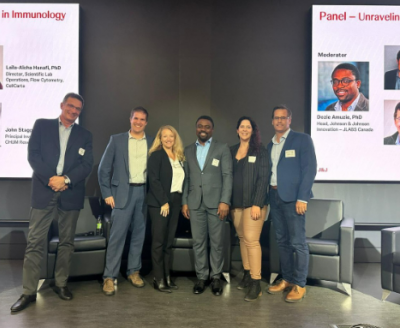
Panel
Amuzie joins fellow immunology leaders for a panel discussion on emerging cell therapies
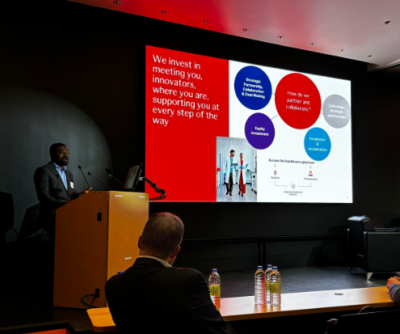
Lecture
Amuzie presents on the future of advanced therapies