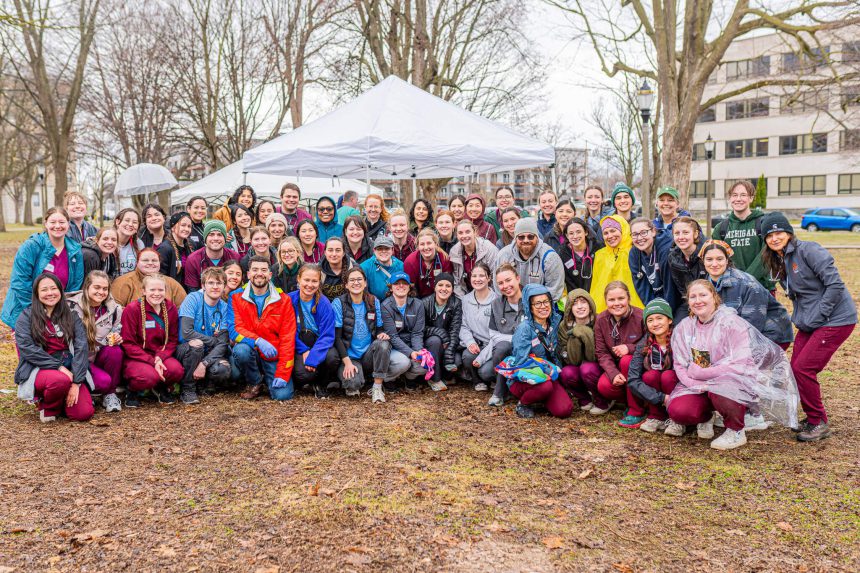
On a chilly March morning, Reutter Park in Lansing looked a little different than usual. Canopies lined the grass, folding tables held medical supplies, and students in scrubs moved quickly between tents, checking in patients, taking vitals, and administering vaccines. The patients were dogs and cats. Their owners, many facing financial hardship or housing insecurity, had come because they had nowhere else to turn.
Delani Stull, a first-year DVM student and e-board member, was working check-in and recalls a moment when a pet owner stopped her with a few simple words.
"My dogs are the reason that I keep going," the woman told her. "My dogs are the reason that I wake up in the morning."
Stull says it is the kind of moment that reminds her why the clinic exists. The woman had tried to find help elsewhere, but many shelters will not accept residents with pets. “Nobody wants to help me because I have two dogs,” Stull recalls her saying, “but I can’t get rid of those dogs.”
That exchange took place at the Michigan Community Street Clinic's spring 2026 event, one of the program's most successful to date. The student-run initiative, organized through Michigan State University's College of Veterinary Medicine, provides free veterinary services to pet owners in need twice a year, bringing care directly into the community.

This spring, the clinic served 56 clients, 22 of them returning, and saw 100 animal patients, including 67 dogs and 33 cats. Students administered 77 rabies vaccines and inserted 28 microchips, reflecting growth from the fall 2025 event, which saw 48 clients and 81 animal patients. Volunteer participation grew as well, with 88 students from across all DVM years, the veterinary nursing program, and undergraduate studies turning out to staff the event.
Faculty advisor David Emery, DVM, who oversees the College's community medicine program, says the numbers reflect something bigger than logistics. "In veterinary school, the demand and rigor of studying can be crazy," he says. "The fact that students are able to organize this and do it says something about them."
The clinic's roots go back further than the events in Lansing. Emery organized the very first street clinic of its kind in inner-city Detroit, a partnership with The Street Dog Coalition, a Colorado-based organization founded by John Geller. The inaugural event treated roughly a dozen animals. It was a modest start for something that would eventually grow to see upward of 100 patients at a single event.
When Emery joined MSU's College of Veterinary Medicine, students Hannah Reetz and Emily Winn approached him about launching their own street clinic event under the MSU banner. The program grew steadily, and this spring's event marked a significant milestone: for the first time, the clinic operated fully independently from the Colorado organization, running entirely under MSU student leadership. A grant secured by club president Isabelle Bembas helped fund supplies.
"It's their thing now," Emery says.
The clinic draws students at every stage of training, and for many it offers something the curriculum can’t replicate. Emery says the gap between classroom medicine and what many pet owners can actually afford has never been more pronounced. "They're taught gold standard medicine, which is fantastic, but they're seeing a population that's not able to afford it," he says. "It teaches them to be like Sherlock Holmes a little bit. If you don't have all the money and can't do all the tests, what are you going to prioritize?"
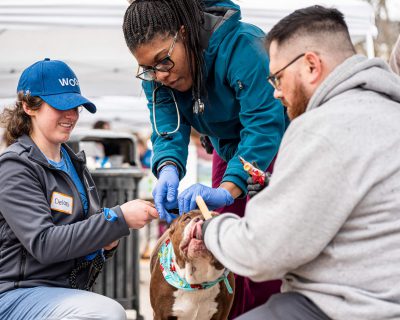
Stull, who has attended every clinic since her time as an undergraduate, says no textbook prepared her for what she encounters at these events. "A book cannot teach you how to talk to people or show care and compassion for their situation," she says. "Books don't teach you how stressful it is to run a clinic with moving parts and all sorts of people running around."
Second-year DVM student Morgan Scanlon pushes back on the idea that community-based care is a lesser version of what happens inside a clinic. "I like to move away from the term gold standard because I think it's sometimes unfair," she says. "It's high-quality care, whether you're in a general practice clinic or in the park getting free veterinary care." Scanlon describes the difference as “contextualized care,” tailoring treatment decisions to what is realistic for each client. She recalls a dog whose owner could not administer oral antibiotics at home. "So we did an injectable and she was covered for seven days," Scanlon says. "It's all about the context and what's best for our patients and our clients."
For students earlier in their training, the benefits are more immediate. Second-year DVM student Elyan Forbis, who has attended every Street Clinic event since starting at the College, says the hands-on experience is invaluable for classmates who have not yet reached clinical rotations. "A lot of students get to practice physical exams, take vitals, and act like the doctor," he says, "which is really great, especially for first and second years."

The impact, though, runs deeper than student development. Emery points to what he calls “shelter aversion,” the clinic's role in keeping animals healthy enough that owners never have to surrender them. "You're seeing adult dogs that you saw originally as a puppy," he says. "These dogs aren't being euthanized, they aren't going to a shelter, they aren't dying because they've received their Parvo vaccine." Emery says this is one of the clinic's most significant contributions, and one of its least visible.
For Stull, the pull was about more than the animals. "As an undergrad, you can't even touch them," she says. "It was the people. Getting to see how happy they were to come here and what a difference we are making in their lives was truly amazing."
Scanlon says the feeling is mutual. "We really believe the effort is demonstrated by showing up, and they do," she says.
The clinic has also grown beyond veterinary care. Through a partnership with MSU's College of Osteopathic Medicine and the Spartan Street Medicine program, the event now treats patients on both ends of the leash. While veterinary students care for the animals, medical students provide blood pressure checks, glucose readings, and basic health screenings for the pet owners themselves.
Forbis, who hopes to expand access to specialized care across Michigan after graduation, sees the clinic as a model worth carrying forward. Stull, only in her first year with the DVM program, plans to stay on the e-board as long as her schedule allows.
"We put a lot of blood, sweat, and tears into making sure every client got seen today, which was truly a feat," Stull says. "But we did it."
For Stull, the clinic brings the purpose of veterinary medicine into focus. "You can be a vet in a small cushy office chair, I guess," she says. "But that's not what veterinary medicine is all about. It's about helping people. It's about getting out there and showing people you care."
For now, the tents are down, and the tables are packed away. But for the pet owners who left with vaccines, microchips, and treatment plans—and for the students who made it happen—the work is far from over. The Michigan Community Street Clinic plans to be back in the fall.