
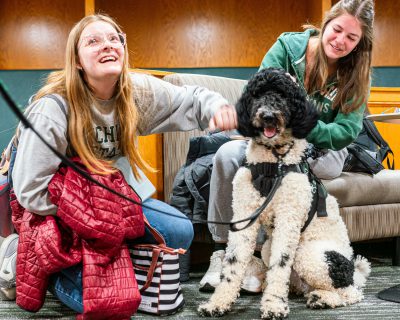
He receives payment in the form of pets. He has been known to kindly join meetings, pop up on students, and spark conversations between people who might have otherwise passed each other without a word. He is Appa, the MSU College of Veterinary Medicine's facility dog, and he just made it official.
After months of weekly training sessions with Canines for Change, Appa has passed his facility dog certification and traded in his "in-training" vest for what his handler, veterinary social worker Jessica Ricker, LLMSW, has affectionately dubbed his "professional blazer."
When the blazer goes on, Ricker says, Appa knows exactly what it means.
"He definitely knows his job," she says. "He struts down the halls with confidence and curiosity, always looking out for people."
The Certification Journey
Unlike a therapy pet, a facility dog is a professionally trained working animal, placed and certified to support the emotional and social wellbeing of a specific community alongside a credentialed handler. For Appa, that means showing up every day alongside Ricker as a clinical extension of the Veterinary Social Work Service. Training a facility dog is no small feat, for the dog or the handler. But for Ricker, watching Appa cross the finish line made it all worth it.
"It's been quite the journey, but to see him develop and pass his facility dog test was so awesome," she says.
Appa and Ricker attended weekly sessions with a cohort of other facility dogs-in-training, most of them destined for school placements. The road had some bumps along the way, but the growth was unmistakable. Mastering long-duration sit-stays, learning to walk off-leash in a close heel, and developing the ability to "place" (a command that instructs Appa to sit or lie down and stay until he is dismissed) marked the milestones that mattered most. When they finally dropped the leash and he heeled right alongside her, Ricker says, it was "such an incredible feeling."
When Appa has his blazer on, something shifts and he understands the assignment, Ricker says.
That discipline runs both ways, and the certification process built something in her, too.
"Bringing Appa into new places and situations has afforded us both the opportunity to grow and develop," she says.
The Human End of the Leash
That partnership didn't happen by accident. Ricker's path to her current role with the College is its own story, and it started with a webinar.
She earned both her undergraduate and master's degrees in social work from Bowling Green State University, with no initial plan to land in a veterinary setting. That changed when she stumbled upon a webinar about the human-animal bond. Intrigued, she sought an internship at a private clinic focused on access to affordable veterinary care, and the rest, as she says, was history.
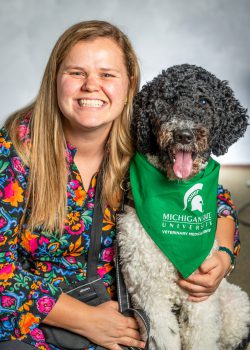
"I just fell in love with how unique it is," she says. "Being able to work with individuals in this way is so rewarding." After graduating, Ricker worked at a senior center as a Social Service Specialist, and then at a human hospital on their Care Navigation Team before the opportunity at the College materialized. She latched on without hesitation.
Her role within the Veterinary Social Work Service is expansive. She supports clients, staff, faculty, and students, meeting people on some of their most difficult days. She facilitates a monthly wellbeing series focused on the eight dimensions of wellness and facilitates an online support group held on the second and fourth Thursdays of each month. That group, she notes, is open to anyone, not just clients of the Veterinary Medical Center or Michigan residents.
"It's open to anyone and everyone," she says. "There's big participation and a good community of folks."
When the opportunity to take on a facility dog came along, it felt like a natural extension of that work. "We're a real team," Ricker says.
Meeting People Where They Are
Social work is built on the principle of meeting people where they are. With a certified facility dog at her side, Ricker has found that concept taking on a new dimension.
Appa functions as a "connector," a point of entry for conversations that might otherwise be difficult to start, Ricker says. When the weight of a hard discussion hangs in the room, his disarming presence can break the tension in a way few tools can.
"He gets people laughing and engaged, and then from there we can talk about the serious stuff," she says.
But Appa’s work extends beyond formal sessions. Ricker describes a moment when Appa pulled her toward a client arriving with an animal for an emergency. The client was overwhelmed and Appa simply sat in front of them.
"He just sits and he just knows," she says. “He can definitely sense the energy around and can support in ways that I can’t.”
Even the College's clinical staff, who work with animals all day, respond differently to Appa.
"Animals coming into the hospital are seeking medical care, and are often sick or injured," Ricker says. "They don't provide the same type of comfort he does, because he's a healthy dog."
Staff who might otherwise pass each other in the hallways stop, squat down, and take a moment. Appa, she says, collects a toll in pets from nearly everyone he encounters, and he will make his disappointment known if someone tries to walk by without paying it.
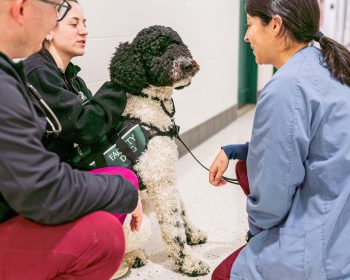
Kindly Disrupting
A typical shift for Appa is impossible to define, because no two days are alike.
He has his regular routes: a particular hospital hallway, the business office, veterinary nursing (a door he can’t pass without saying hello), the dean’s office, and the student break rooms. But his most resonant moments often come unplanned.
Not long ago, Ricker brought him into the student center late in the day, vest off, running free. One student started zooming around with him. Then study room doors began opening, one by one, as students filed out to see what was happening.
"It took them out of their study realm and made them come out and connect," Ricker says. "We love to kindly disrupt."
That phrase, kindly disrupt, has become something of a personal mission statement for the pair. Appa has earned, in Ricker's words, "a badge in kindly disrupting meetings." People welcome it.
Everyone's Dog
What began as an asset for the Veterinary Social Work Service has quietly grown into something larger: a shared sense of community ownership.
"He's not just part of the social work team or the Office of Health and Wellbeing," Ricker says. "He is everyone's dog."
His reputation extends well beyond the building's walls. At the white coat ceremony earlier this year, Ricker overheard students whispering to their families and pointing him out as Appa made his way through the reception.
"People were saying, 'That's Appa. That's our mascot. That's our College of Veterinary Medicine's dog,'" she recalls.
For Ricker, that moment captures the long-term vision: not just immediate comfort, but a culture of connection. People pausing their work, dropping their focus for a moment, and remembering to acknowledge each other.
Appa, blazer on, is ready for the work.
Want to see Appa in action? We attached a GoPro to his back and followed him through a day at the CVM.
Appa is a facility dog with the MSU College of Veterinary Medicine's Veterinary Social Work Service, in partnership with Canines for Change. Jessica Ricker, LLMSW, serves as his handler. For information about the support group or social work services, visit cvm.msu.edu.