
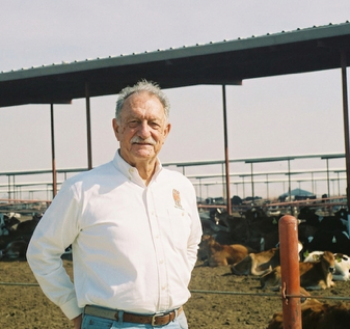
Victor Cortese’s (DVM ’80) journey in veterinary medicine began in an unlikely place for a city kid: a farm in Michigan’s thumb. That early experience sparked a lifelong passion for animal health, eventually leading him to a distinguished career in mixed animal practice, industry, and research. Along the way, he has contributed to global cattle health initiatives, earned board certification and a PhD, and co-authored a comprehensive textbook on bovine immunology. In this Q&A, Cortese reflects on his path, the challenges and rewards of writing a book, and advice for the next generation of veterinarians.
What initially drew you to veterinary medicine? What about bovine immunology specifically?
Even though I was a city kid, in sixth grade, I had the chance to work on a farm with mixed animal veterinarians in the thumb of Michigan. I was hooked! I practiced in Wisconsin but eventually had to leave due to some vision problems. I ended up working with renowned immunologists Drs. Tizard and Roth, and they sparked my interest in immunology. At that time, I had already done work in the industry as a bovine tech services vet.
Can you briefly describe your career path after graduating?
I joined a mixed animal (primarily cattle) practice in Wisconsin and became a partner in the practice. When I decided to leave practice, I joined a small company as the lead tech services vet, and then eventually moved to SmithKline Beecham as a cattle specialist. (SmithKline Beecham later became Pfizer and then Zoetis.) While there, I became board certified by the American Board of Veterinary Practitioners (dairy specialty) and earned my PhD from the Western College of Veterinary Medicine at the University of Saskatchewan. I have been truly blessed to travel the world and work with veterinarians and cattle producers in so many different countries and states.
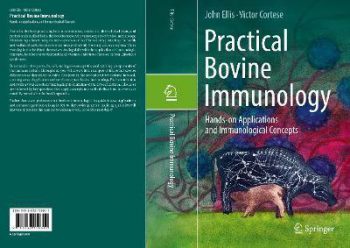
What inspired you to write Practical Bovine Immunology?
I was lecturing for the Ruminant Veterinary Association of South Africa at the World Veterinary Congress when Springer Nature Publishing approached me and invited me to write a textbook!
What was the process of writing it like? Were there parts you found most challenging or most rewarding?
It was a daunting task, so I asked my major professor and friend Dr. John Ellis to co-author it. The hardest part was coming to an agreement on the style and format of the book. However, the combination of both visions made for a better book. He expanded my knowledge of areas in immunology that were outside my research scope, many of which are included as chapters in the book.
What do you remember most about your time as an MSU student?
The three-year program was intense to say the least, but it also fostered a closeness within our class.
What is something you learned in veterinary school that you still use today?
The ability to communicate at different levels, from farmers to PhDs. Those skills have been essential in my career, and they were fostered during my time as a student.
Do you have any advice for current veterinary students?
Large animal practice is a great profession that needs you. Also, the core disciplines need more graduate students to continue basic research and teaching. Don’t assume you will only ever work in a practice; you never know what life has in store for you!