
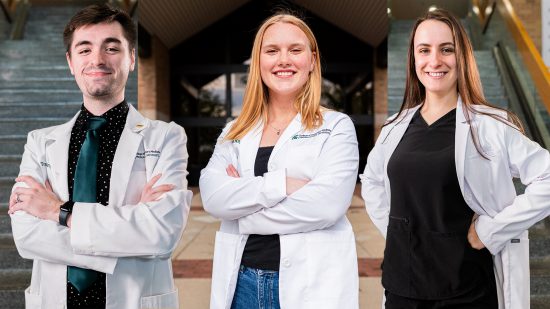
In the summer of 2021, a group of aspiring veterinarians gathered on the Michigan State University campus for a program that has helped shape the College of Veterinary Medicine’s student body since 1978. The Enrichment Summer Program, founded under the name Vetward Bound by Patricia Lowrie to expand access to veterinary education for students from underrepresented groups, brought together dozens of pre-vet prospects for an intensive look at what veterinary school demands. Three of them—Travis Boling, Bria Kilgore, and Carrie Kosiba—would all be accepted to the College the following year. All three will graduate on May 8.
The significance of that shared starting point is not lost on them. Their paths to veterinary medicine were distinct, shaped by different upbringings, different mentors, and different defining moments. But the thread through each of their stories leads back to the same summer.
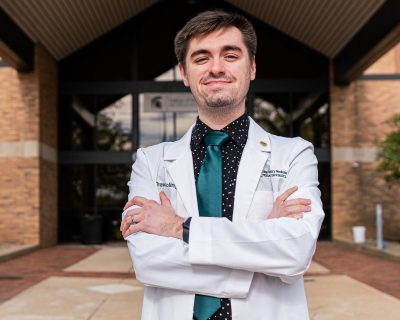
A Lansing Student Who Almost Chose Music
Travis Boling grew up in Lansing, just miles from the campus where he will soon receive his veterinary degree. He had always felt a connection to animals, but by the time he reached college, he was drawn in another direction: music.
While navigating these doubts about his future in medicine, his academic advisor, Micaela Flores, encouraged him to apply for the Enrichment Summer Program. For Boling, the program was a chance to see if he could truly envision himself in the veterinary profession.
“The time when I truly knew I wanted to be a veterinarian was during the Enrichment Summer Program,” Boling says. “Learning anatomy and physiology lit a passion within me, and during that time, I realized that this is what I was meant to do for life.”
Later, as a veterinary student, he found his calling within the profession: emergency medicine.
During his second year, while working as a student employee in the Veterinary Medical Center, Boling was helping with a case involving a dog experiencing a difficult labor. After the animal was taken to surgery for a cesarean section, he thought everything was finished.
“What stuck out to me was that Dr. Nessa Levy asked me to come help catch puppies,” Boling says. “Assisting during that time meant the world to me, and being able to learn from this case in as many ways as I could solidified that I wanted to be an emergency doctor.”
After May 8, Boling will move to Chicago to train as an emergency veterinarian with Veterinary Emergency Group through their New ER Doctor program, also known as NERD.
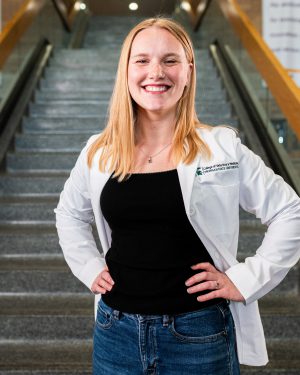
Finding Balance in the Beehive
Bria Kilgore’s road to veterinary medicine was not a straight line. She grew up in Fenton, Michigan and changed her career plans more than once, and eventually found herself working two jobs while attending school full-time: nights as a medical technician at a nursing home, mornings at a general practice clinic. It was in that clinic, during the height of the COVID-19 pandemic, that something became clear to Kilgore.
“People’s pets were directly impacting mental health during the pandemic,” she says. “So, it was great to be a part of treating the smallest members of someone’s family.”
Kilgore learned about the Enrichment Summer Program through her school’s pre-veterinary club. Balancing her jobs while pursuing her application, the program offered something she valued: direct access to MSU College of Veterinary Medicine faculty and clinicians, and support with the application process.
Once enrolled, her path took an unexpected turn through the world of apiculture, the science and study of managing beehives and breeding honeybees to produce honey and pollination. Kilgore became heavily involved in the Honeybee Medicine Club, a student organization focused on an emerging area of veterinary practice. Since 2017, the U.S. Food and Drug Administration has recognized honeybees as food-producing animals, a designation, Kilgore notes, that has changed the field, placing veterinarians at the forefront of diagnosing and treating diseases that threaten both bee populations and the global food supply.
“I met so many amazing soon-to-be doctors in this club and was a part of educating apiarists and other veterinarians in how essential honeybees and their health are to our food chain,” she says.
After graduation, Kilgore has signed with a general practice in Jackson, Michigan, and she plans to eventually launch her own LLC as a honeybee veterinarian.
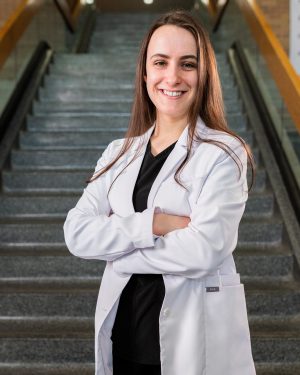
A Lifelong Calling, Refined
Carrie Kosiba, a Saline, Michigan, native, always knew she wanted to be a veterinarian. Rather than testing her interest, the Enrichment Summer Program equipped her with the academic and social stamina required for vet school.
“The program greatly prepared me by allowing me to practice studying for the didactic portion and familiarized me with the expectations for clinical students,” Kosiba says. “It encouraged me to approach vet school with a collaborative mindset and to rely on my peers, which has been a significant component of my veterinary school experience.”
That collaborative spirit eventually shaped her clinical perspective. While rotating through the emergency service, Kosiba realized that a veterinarian's role extends far beyond medical treatment.
“Being an educator is a huge portion of our career,” she says. “Taking the time to effectively communicate with clients has an immense impact on the outcome for the patient.” Now preparing to graduate, Kosiba has accepted a position as an associate veterinarian at an emergency hospital. “I plan to be the type of veterinarian who is highly empathetic and understanding,” she says. “I will always prioritize the patient’s wellbeing and be a strong advocate for them.”
Founded in 1978 by Patricia Lowrie, the Enrichment Summer Program’s mission has remained constant for nearly five decades. Today, its impact is best seen in the success of the graduating class.
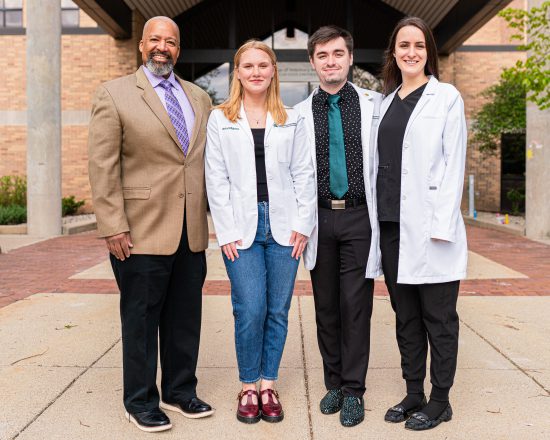
“Bria, Carrie, and Travis have not only been successful in the DVM program, but each has also enriched the MSU College of Veterinary Medicine community through their leadership and participation in activities outside of the classroom,” says Dr. Stephan Carey, Associate Dean for Student Engagement and Success. “Their commencement represents a celebration of their individual achievements, but it also speaks to the legacy of the Enrichment Summer Program—a testament to the vision of Lowrie and Dean John Welser in broadening access to veterinary medical education.”
As these three new doctors step into their careers, they carry with them a legacy of excellence and a commitment to a more inclusive future for the profession.