By Kelsie Donaldson on September 18, 2026
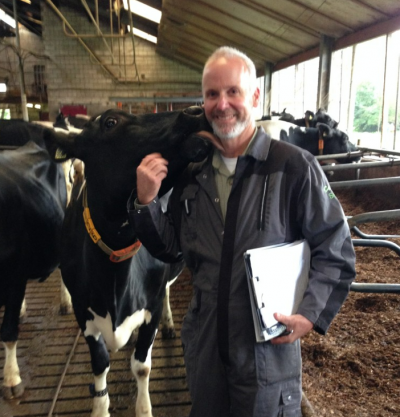
Mark Fox Cow Lick

When Mark Fox (DVM ’84) looks back on his more than 40 years in veterinary medicine, he remembers the people as much as the work. From the dairy farmers who first sparked his interest in veterinary medicine to the classmates, mentors, colleagues, and students who have shaped his career, Fox has always found something to learn from the people around him. So when he was named the 2026 American Association of Bovine Practitioners (AABP) Bovine Practitioner of the Year, he was quick to see the award not as an individual accomplishment, but as a reflection of the many people who have been part of his journey. In honor of the award, we sat down with Fox to look back on his journey, the people who influenced him, and the lessons he’s picked up along the way.
What first drew you to veterinary medicine, and specifically to bovine medicine?

I grew up in Fremont, Michigan, and worked on a dairy farm throughout junior high and high school. After I lost my dad during my senior year, our neighbors really took me in and became like surrogate parents. They were wonderful dairy farmers, and they sparked my interest in dairy cattle and everything that goes along with dairy farming.

When I started college at Central Michigan University, I initially planned to pursue graduate school in zoology or a related field. But during my senior year, I started thinking seriously about veterinary medicine. I applied to MSU and was accepted on my first try. Along the way, I was fortunate to have a lot of good people supporting and inspiring me.

What do you remember most about your time at MSU?

What I remember most is the people. Coming from a small-town farming background, MSU felt like a big university, but our class of about 100 students quickly made it feel much smaller. We got to know each other well, and some of the friendships I made at MSU have lasted decades. I also had some wonderful faculty mentors who had a tremendous influence on me and my interest in large animal and dairy medicine. They shared not only their knowledge in the classroom but also their experiences and stories, which made the education and mentorship I received at MSU especially meaningful.

What did your career path look like after graduation?

After graduating in 1984, I began my career at Deckerville Veterinary Clinic, where I completed an externship during veterinary school. I had originally thought I might return to my hometown and start a practice of my own, but my experience at Deckerville changed my perspective. It was a six-doctor practice, and I saw the value of working alongside experienced veterinarians, learning from one another, and eventually mentoring younger veterinarians myself.

I’ve been there ever since! Over the years, the practice grew to 13 veterinarians, with about 8 focused on large animal medicine, primarily dairy. We built a new facility in Sandusky and became Thumb Veterinary Services, but the practice has maintained the same family-oriented philosophy and commitment to collaboration. So, I’ve been fortunate to have a rather unusual career path—just one location!

What does a typical day for you look like now at Thumb Veterinary Services?

These days, I’m working about half time, which looks a little different than it did earlier in my career. I still do some scheduled herd health visits, but I spend more time consulting with farms on preventive care, management, and employee mentoring. I also continue to work closely with nutritionists, which has always been a particular interest of mine.

What hasn’t changed is how much I enjoy the people and relationships. Veterinary medicine may focus on animals, but it’s really a people industry, and after practicing in the same community for so many years, many of those relationships have become like family.

How has the field of bovine veterinary medicine changed since you started?

The biggest change has been consolidation. When I started in 1984, Michigan had nearly 1,000 dairy herds in just a few counties. Today, there are about 900 herds statewide, but with far more cows. Herds have become larger and more specialized, and that has changed the way veterinarians work with farms.

We tend to spend more time on farms doing herd health, reproductive work, consulting, and preventive care rather than responding to individual sick-animal calls. As farms have grown, their employees have also gained more training and expertise, allowing them to handle many things that veterinarians once did themselves.

At the same time, diagnostics have continued to improve. The fundamentals I learned early in my career are still incredibly valuable, but we have better tools to understand what’s happening within a herd and develop practical strategies to address those challenges.

What advice would you give to students interested in food animal or bovine medicine?

You don’t have to come from a farm background to pursue food animal or bovine medicine. As the industry has changed, fewer students grow up on farms, but that shouldn’t be a barrier. My advice is to get out there and gain hands-on experience. Spend time on farms, shadow veterinarians, and pursue externships to get a feel for the work and understand what it takes to care for food animals every day.

I’d also encourage students to build relationships and find mentors. Mentorship goes both ways. Experienced veterinarians can share what they’ve learned, but students bring new perspectives, energy, and questions that can teach us, too. One of my favorite things is taking students to farms and simply asking, “What do you see?” They often notice things I didn’t.

Finally, remember that this is a service profession. We work with animals, but ultimately, it’s about people and relationships. Producers are business owners who want partners who understand their operations and genuinely want to help. If you approach those relationships with honesty and a willingness to be part of something bigger than yourself, you can build a very rewarding career.

What does winning AABP Bovine Practitioner of the Year mean to you?

It meant a great deal to me, and it was a very humbling experience. When I accepted the award, I was genuinely surprised, and I think part of what made it so meaningful was recognizing how much of a team effort it really was. I’ve been fortunate to have wonderful clients, partners, colleagues, and family members who have invested in me throughout my career.

Anything else you’d like to touch on?

One more piece of advice I’d like to give students: give yourself grace. Veterinary students are high achievers, and they’re used to succeeding at a very high level. But when you enter practice, you quickly realize that not every day is going to go according to plan. There will be difficult cases, tough decisions, and days when you go home feeling like you didn’t accomplish what you wanted to. That’s part of the profession. Having good people around you—whether that’s family, colleagues, mentors, or a supportive practice team—can make all the difference. We have to give ourselves permission to learn and keep moving forward.

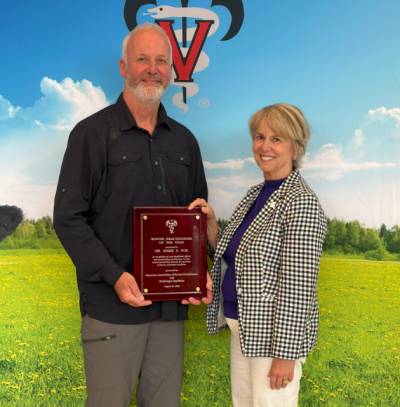
Mark Fox Award

A Word from the Herd

Fox’s friend and classmate, Dr. Pam Ruegg, nominated him for the AABP award. In her nomination letter, Ruegg writes, “Over the course of more than four decades in dairy practice, Dr. Fox has exemplified the highest ideals of bovine veterinary medicine through his unwavering commitment to dairy producers, his leadership in herd health management, and his commitment to always ‘listening to the cows.’ His dedication to bovine medicine and strong ethical foundation have always been evident, and his impact on our profession has been profound.”