
A new study from the MSU College of Veterinary Medicine shows that single-dose gene therapy did more than halt inherited blindness in adult retinas—it actually prompted mature cells to rebuild damaged connections and recover lost vision.

When researchers at the Michigan State University College of Veterinary Medicine recently restored vision in adult dogs using retinal gene therapy, they expected to see functional improvements. What surprised them was what happened to the physical structure of the eye: it actually rewired itself.
The study, led by assistant professor, and former resident Billie Beckwith-Cohen, DVM, PhD, DACVO alongside endowed professor Simon Petersen-Jones, DVetMed, PhD, DECVO, challenges long-held assumptions about the ability of mature mammalian nerve cells to repair themselves.
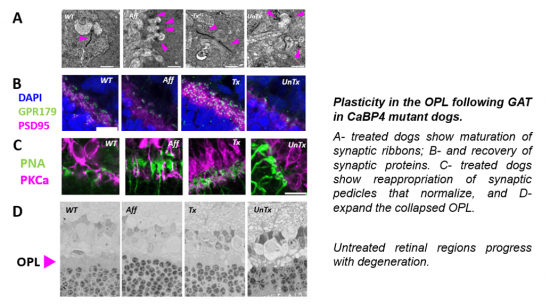
The team investigated CaBP4 gene therapy, a treatment for a rare inherited condition that disrupts calcium signaling between light-sensing cells and the brain. They found that the therapy did far more than simply halt disease progression. According to the study, the single-dose treatment prompted adult retinas to rebuild damaged connections, thicken, and recover lost visual function.
Fixing the "Typo in the Blueprint"
To explain how gene therapy can restore this pathway, Beckwith-Cohen compares genetic mutations to an error in a building plan.
"One can essentially discuss the mutations in the retinal gene as a typo in a blueprint that makes the instructions incomprehensible to the system, resulting in a faulty design and subsequent vision loss," says Beckwith-Cohen. "Our therapy essentially provides new instructions for the misspelled segment, like an editor."
While the research team expected to see functional recovery, Beckwith-Cohen notes that the extent of the physical restoration in fully developed retinas was particularly compelling.
"In this paper we were able to show three independent structural changes supporting plasticity in the adult retina," Beckwith-Cohen says. "Not only were new components added, but pre-existing abnormalities were repaired."
Why Dogs Hold the Key to Human Sight
To test the therapy, the researchers studied dogs who naturally developed the condition. Beckwith-Cohen says that studying spontaneous disease in dogs provides a vital stepping stone toward developing effective treatments for human childhood blindness.
"Dogs with spontaneous diseases have two major advantages over other common model systems such as rodents when we think of stepping stones to cure human disease," Beckwith-Cohen says. "The first has to do with the similarities of the canine eye to the human eye. Dogs have large eyes, well-developed vision, and regions of high cone density that provide superior visual acuity compared with rodents."
Additionally, because the condition develops naturally in dogs rather than through artificial genetic modifications, Beckwith-Cohen says it provides a more reliable representation of how genetic mutations manifest in humans.
Canine research at the College has a long-standing track record of advancing therapies from the lab to human clinical trials. Petersen-Jones has spent decades leading preclinical canine gene therapy research at MSU—including high-impact work on CNGB1 retinal models that helped bridge the gap to human applications. This approach builds on a legacy in ocular gene therapy that dates back to Lancelot, a dog treated at the University of Pennsylvania whose research helped lead to the first FDA-approved human retinal gene therapy.
A New Horizon for Vision Loss
While CaBP4 mutations cause a rare form of inherited blindness, the researchers believe their demonstration that adult retinas can repair damaged neural networks raises broader possibilities for future treatments.
By showing that the adult eye retains the capacity to reorganize and rebuild, the study offers fresh hope that some forms of vision loss, once thought to be permanent, might one day be recoverable.
These findings, the culmination of 10 years of studies in the Petersen-Jones lab. which included identification of the gene mutation and development of a gene therapy treatment, were reported in Molecular Therapy Advances.