When Sarah Overland first found a newborn donkey in her barn, it was a complete surprise. Overland had not noticed any signs of pregnancy in her recently rescued jenny, but one morning while checking on the donkey, she discovered a tiny foal standing beside its mother.
Overland named the foal Bobby, and for the first few weeks, he seemed to be doing well. But one cold weekend, something changed. “He was still walking around and trying to nurse. But he didn’t want to interact with anyone, which was really out of character for him,” says Overland. “I knew then that something was wrong.”
Overland considered waiting until Monday to have Bobby seen, but after a call with her veterinarian, she decided to seek emergency care and put in a call to the Michigan State University Veterinary Medical Center.
A Rapid Response
From that very first phone call, Overland felt like she was in good hands. “I got to talk directly to the doctor,” she says. “She told me exactly what to do—even how to transport him safely—and asked us to call when we were about 30 minutes away so the team could be ready.”
When Overland arrived, a team of Large Animal doctors and nurses—led by Dr. Ana Moreira and residents Drs. Emily Hess and Lindsay Dennis—quickly got to work. “They were focused, organized, and incredibly steady,” Overland says. “I’m a medic, and I could tell that the situation was serious, but the care team never showed panic.”
Bobby’s clinicians identified multiple concerns, including hypothermia, pneumonia, and a high risk of sepsis—life-threatening conditions for newborn equids. There were also some signs, such as Bobby’s small stature and floppy ears, that he was born prematurely. He was admitted to the Veterinary Medical Center for around-the-clock care.
Compassionate Care
For newborn equids facing life-threatening illness, immediate and intensive intervention is crucial. “In neonates, the risk of sepsis is high. Early referral to the hospital is paramount for the best chance of a successful outcome,” explains Moreira. “At the Veterinary Medical Center, we provide 24/7 nursing care to all our patients. Additionally, our facility is fully equipped to deliver advanced critical care. This includes active rewarming for hypothermic neonates such as Bobby, supplemental oxygen therapy including high-flow oxygen therapy, continuous intravenous fluid therapy, and access to a plethora of diagnostic tools.”
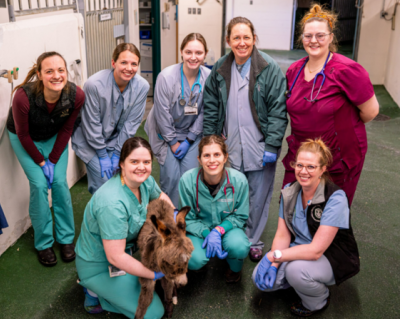
While Bobby received specialized treatment, Overland and her family were also supported every step of the way. “They let us stay with him while they worked,” she recalls. “And when I got overwhelmed, they told me it was okay to step out. They showed Bobby so much care, and they were equally accommodating to us.”
Throughout Bobby’s treatment, the veterinary team provided regular, honest updates on his progress. “They never promised outcomes,” says Overland. “They were transparent—he’s improving, here’s what we’re seeing, here’s what we’re watching for. That honesty helped us make informed decisions and feel involved in his care.”
Frequent visits allowed Overland to see Bobby’s gradual recovery—from needing tube feedings to drinking on his own, gaining strength, and beginning to explore his surroundings.
“I’d be visiting him and hear the doctors and nurses say, ‘I’m going to see the baby!’” Overland laughs. “Everyone just showed him a lot of love.”
Turning the Corner
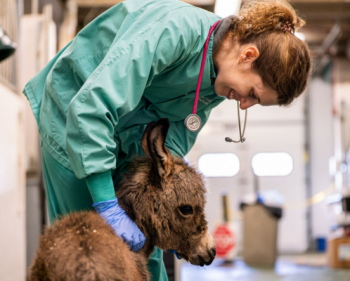
Over time, Bobby began to show more signs of improvement. He gained weight, became more active, and even developed a playful personality that quickly won over caregivers.
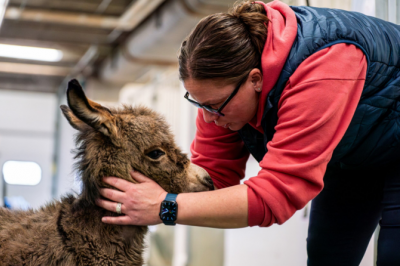
“As Bobby responded to medical therapy, his long fuzzy ears went from very floppy to little antennas, always searching for the next human to provide extra cuddles,” says Moreira.
“There was a moment when I asked Dr. Hess if we could start thinking about how long recovery would take instead of whether he would recover at all,” Overland recalls. “When she said yes, that was a pivotal point for me.”
Today, an energetic and affectionate Bobby is doing well back at home.
“He demands kisses,” says Overland. “He just shoves his nose into your face until you give him one.”
A Word of Advice
In reflecting on the experience, Overland encourages others who may be in a similar position to trust their instincts and seek care if something feels off.
“Don’t wait,” she says. “If you think something isn’t right, get them seen as soon as possible. I didn’t realize how sick he was right away, and I’m so grateful we made that call when we did.”
Bobby’s care was supported by generous donors to the Big Babies Fund, which covers costs for large animal neonates at the Veterinary Medical Center.