
East Lansing may not have been chosen to host the 2026 Winter Olympic Games, but MSU’s campus is not short of wintry competition, thanks to the CMIB Science Slam.
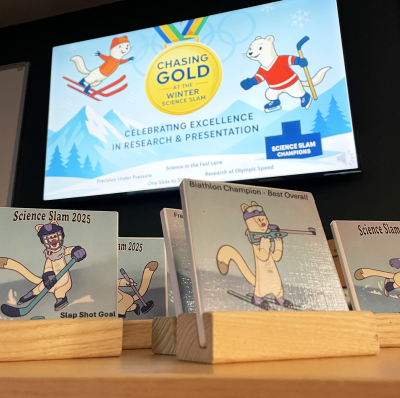
The annual event, hosted by the College of Veterinary Medicine’s Comparative Medicine and Integrative Biology (CMIB) Graduate Program, is an exhibition/competition of graduate student research. But rather than emphasize the scientific innovation, this event highlights another critical skill for investigators: communication.
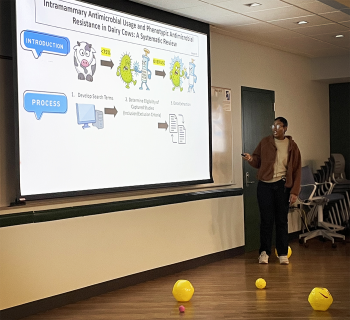
Competitors are given just two short minutes and a single PowerPoint slide to convey the most important details of their work—no small feat for researchers who dedicate so much of themselves and their time to a hypothesis. Judges award medals based on the effectiveness, creativity, and clarity of presentations. And for those who go over their allotted time? They’re (gently) pelted with emoji-printed beach balls from an audience of peers.
Communication: The Secret to Success
“One of the most important competencies of a scientist is to be able to clearly explain their work,” says Dr. Colleen Hegg, CMIB director. “The event showcases that ability: condensing complex ideas to just one slide and two minutes of brilliance.”
She designed Science Slam, which was in fact themed around the Olympic Games this year, to help students hone this tricky skill that will benefit them throughout their careers. Not only are science communications important to help others (including other scientists and the general public) understand research, they can also help to attain funding, support, and resources.
Hegg’s most important tip for science communication? “Keep it simple,” she says. Successful presenters clearly frame the underlying questions of their research, utilize strong visuals, and speak with purpose. There’s also a time and place for pop culture references—several Science Slam competitors employed superhero comparisons and witty memes to engage listeners and illustrate concepts.
And the Winners Are…
About 20 students presented their work, all of which was adjacent to veterinary medicine and research. Topics ranged from the pressing subject of how dairy farmers can protect their herds from avian influenza to the complex mechanics behind liver regeneration and tumor initiation (which may one day lead to better treatments and therapies), among many other topics.
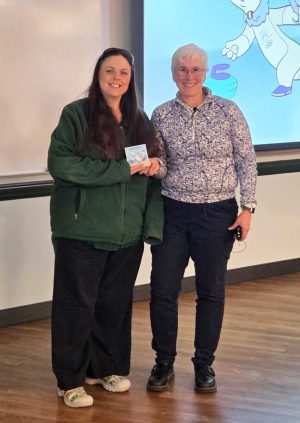
And while all presentations represent medal-worthy work, only six were awarded a coupon for a free scoop of MSU Dairy Store ice cream and a coveted Science Slam plaque.
The winners were:
- Freestyle Flair; the most humorous or creative presentation: Kaylin Carpenter, Gisela Sobel Hussey Lab
- Speed Skater’s Precision; the presentation with the most data presented clearly and comprehensibly: Christine Wei, Jim Luyendyk Lab
- Figure Skating Elegance; the presentation with the most visual appeal: Sydney Stolworthy, Shawn Zimmerman Lab
- Skeleton Run; the most polished, stylish presentation: Alanis Torres-Berríos, Ker Sant Lab
- Curling Curveball; the judge’s choice award: Jamie Douglas, Dalen Agnew Lab
- Biathlon Champion; best overall presentation: Ahmed Tantawy, Carolina de Aguiar Ferreira Lab
While the parallels to the Olympic Games are timely, they’re also a fitting metaphor no matter the time of year.
“When I think of an Olympic athlete, I think of someone who puts countless hours to perfect their skills,” says Hegg. “CMIB graduate students have spent years building their knowledge base and perfecting their analytical abilities to master the art of scientific discovery.”
And when it comes to scientific innovation that leads to discoveries that better the world, we all win gold.
The Comparative Medicine and Integrative Biology Graduate Program, which is home to about 60 students at any given time, positions graduates to translate advances in biology into the prevention and treatment of human and animal disease. Interest areas include medical genomics, comparative ophthalmology and orthopedics, infectious disease, food safety, microbial evolution, neuroscience, pharmacology and toxicology, population medicine, epidemiology, pulmonary biology and disease, reproductive biology, virology, and more.
The program develops well-rounded, passionate scientists who will become the next generation of leaders in scholarly research, teaching, public policy, clinical practice, and healthcare.